
.jpg)
What is graphite?
Graphite is elemental carbon arranged in stacked sheets. Natural material can contain clay, silicate, sulfide, or other impurities, and carbon-rich rock may contain graphite too fine to identify confidently by eye.
What does graphite look like?
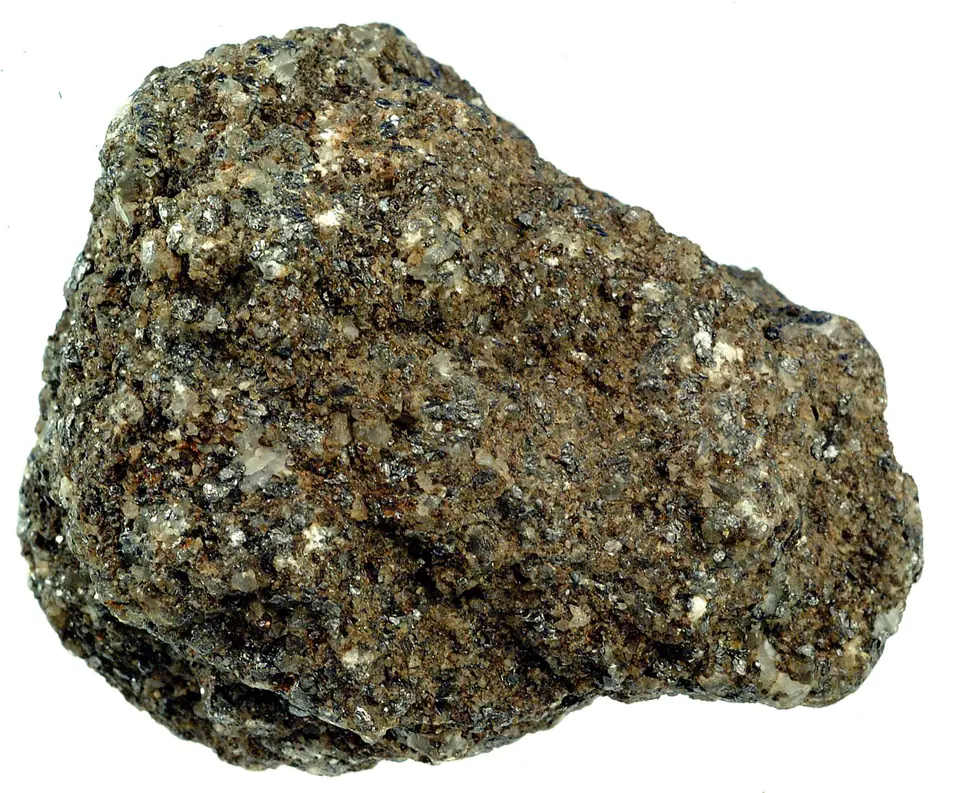
Graphite occurs as platy flakes, scaly masses, earthy material, disseminated grains, and vein fillings. Crystalline flakes are metallic gray and flexible but not elastic.
Fine graphite can make rock look black or silvery and may coat fingers. Weathering and mixed host rock can obscure its characteristic luster and feel.
Identification tests
Begin with observation and use the least destructive test first. Results can change with weathering, mixtures, coatings, and grain size. Review the step-by-step field-test methods before altering an unfamiliar specimen.
Hardness
About 1 to 2Scratched very easily by a fingernail.
Streak or mark
Dark gray to blackLeaves a mark readily, unlike many hard metallic minerals.
Density
Low; specific gravity about 2.2Feels light compared with galena or molybdenite.
Cleavage and feel
Perfect basal cleavage; greasy feelSupports a layered carbon mineral but should be combined with density and hardness.
Useful procedures: Mohs hardness test · Mineral streak test · Specific gravity and density test · Cleavage versus fracture
Common lookalikes
Molybdenite
Much denser, commonly bluish silver, and may leave a greenish-gray rather than black mark.
Galena
Far denser, brittle, cubically cleaved, and brighter lead-gray.
Biotite
Forms elastic mica sheets and is harder, with a lighter streak.
How does it form?
Much graphite forms when carbon-rich sedimentary material recrystallizes during regional or contact metamorphism.
Graphite also occurs in veins, pegmatites, some igneous rocks, and unusual mantle-derived material. Its texture and host rock help distinguish flake, vein, and amorphous deposit styles.
Geologic setting and occurrence
Graphite is found in metamorphic belts, carbon-rich schists and gneisses, marbles, veins, and selected igneous settings. Grain size and purity vary widely.
A pencil mark is not proof of graphite in a rock because soot, soft sulfides, and manufactured materials can also mark surfaces.
Uses and significance
Graphite is used in batteries, refractories, lubricants, foundry products, brake linings, pencils, conductive materials, and specialized high-temperature components.
Field notes
- Avoid inhaling fine graphite or mixed mineral dust.
- Do not use electrical conductivity as a casual field test near live circuits.
- Industrial suitability depends on flake size, purity, structure, and processing tests.
This guide supports preliminary field identification, not a laboratory determination, appraisal, hazard assessment, or statement of ownership or collecting permission. Verify land status and local rules before handling or collecting material.
Authoritative sources
LithoMap wrote this guide in original language using the scientific concepts and physical-property standards supported by these sources.
- Graphite Statistics and Information U.S. Geological Survey
- Minerals and their physical properties U.S. National Park Service
- Mohs Hardness Scale U.S. National Park Service
- Natural Gemstones: Mineral Gemstones U.S. Geological Survey
Editorial review: September 17, 2026.