
.jpg)
What is molybdenite?
Molybdenite is molybdenum disulfide, MoS₂. Rhenium may substitute in small amounts, but appearance cannot determine trace-element content or ore grade.
What does molybdenite look like?
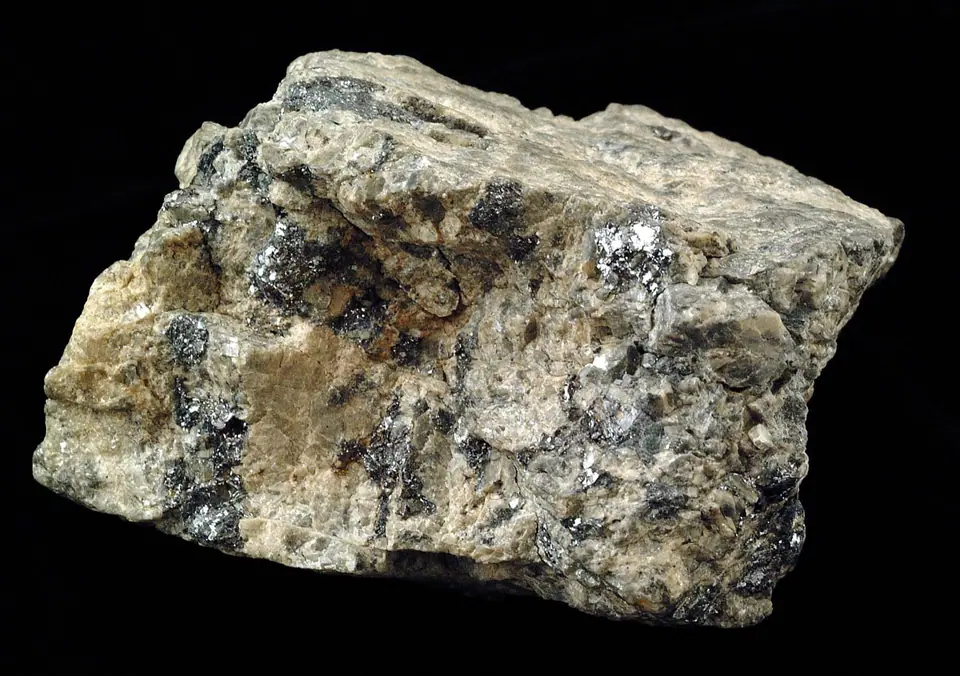
Molybdenite forms platy hexagonal crystals, foliated masses, rosettes, and disseminated flakes. Fresh surfaces are metallic bluish gray and may leave a gray to greenish-gray mark.
Thin flakes bend but do not spring back. Oxidation can dull surfaces or produce yellowish secondary molybdenum minerals.
Identification tests
Begin with observation and use the least destructive test first. Results can change with weathering, mixtures, coatings, and grain size. Review the step-by-step field-test methods before altering an unfamiliar specimen.
Hardness
About 1 to 1.5Scratched very easily, similar to graphite.
Streak or mark
Gray to greenish grayOften lighter and greener than graphite’s black mark.
Density
High; specific gravity about 4.6 to 5.1A compact piece feels much heavier than graphite.
Cleavage and tenacity
Perfect basal cleavage; flexible, nonelastic flakesConfirms a soft layered mineral but not molybdenite alone.
Useful procedures: Mohs hardness test · Mineral streak test · Specific gravity and density test · Cleavage versus fracture
Common lookalikes
How does it form?
Molybdenite commonly crystallizes from hydrothermal fluids in porphyry molybdenum and porphyry copper systems, quartz veins, greisens, and skarns.
It may occur with quartz, feldspar, pyrite, chalcopyrite, fluorite, scheelite, and alteration minerals. Sparse flakes do not establish economic grade.
Geologic setting and occurrence
Molybdenite is widespread in certain granitic hydrothermal systems but is rarely abundant in an ordinary hand sample. Weathering can remove or alter exposed flakes.
Field identification should be confirmed where resource, environmental, or processing decisions depend on it.
Uses and significance
Molybdenite is the principal source of molybdenum, used in alloy steels, stainless steels, catalysts, pigments, lubricants, and high-temperature applications.
Field notes
- Avoid grinding sulfide-bearing material or inhaling dust.
- A few visible flakes do not establish a mineable molybdenum deposit.
- Do not enter adits, trenches, or unstable exploration workings.
This guide supports preliminary field identification, not a laboratory determination, appraisal, hazard assessment, or statement of ownership or collecting permission. Verify land status and local rules before handling or collecting material.
Authoritative sources
LithoMap wrote this guide in original language using the scientific concepts and physical-property standards supported by these sources.
- Molybdenum Statistics and Information U.S. Geological Survey
- Minerals and their physical properties U.S. National Park Service
- Mohs Hardness Scale U.S. National Park Service
- Natural Gemstones: Mineral Gemstones U.S. Geological Survey
Editorial review: September 17, 2026.