

What is diamond?
Diamond is carbon arranged in a three-dimensional crystal framework. Trace elements and structural defects can produce yellow, blue, brown, pink, green, and other colors. Carbon composition alone does not distinguish natural from laboratory-grown diamond.
What does diamond look like?
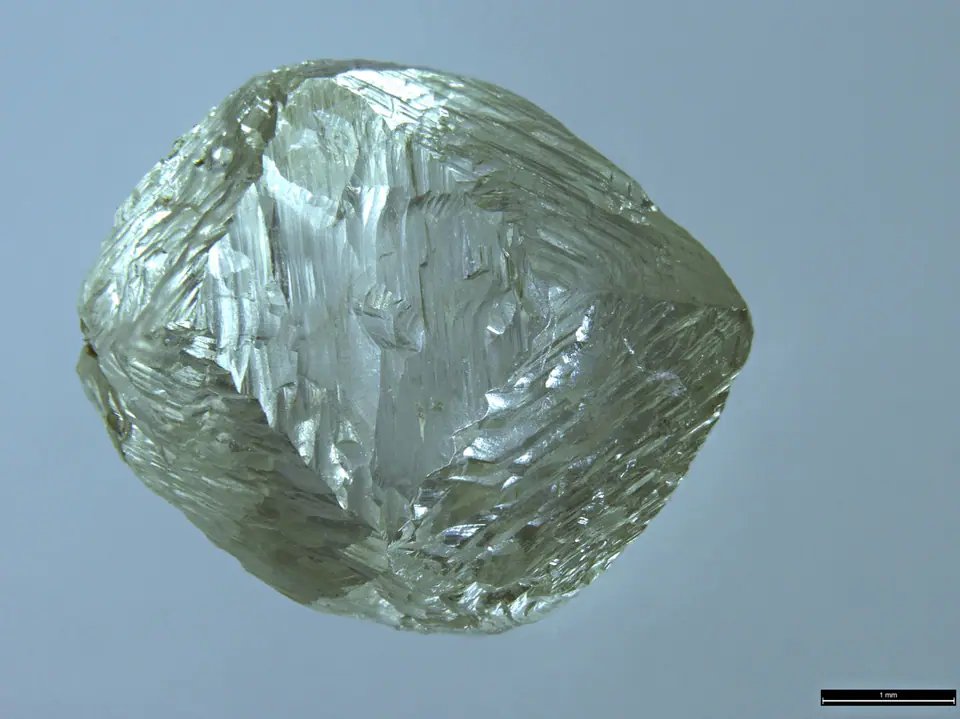
Rough diamond may form octahedra, cubes, twinned shapes, rounded dodecahedral forms, or irregular fragments. Surfaces can be frosted, etched, greasy-looking, or highly reflective.
Transparent appearance is not required, and visual inspection cannot reliably separate every diamond from quartz, corundum, zircon, moissanite, glass, or synthetic material.
Identification tests
Begin with observation and use the least destructive test first. Results can change with weathering, mixtures, coatings, and grain size. Review the step-by-step field-test methods before altering an unfamiliar specimen.
Hardness
10Diamond scratches other common minerals, but scratch testing can damage specimens and is not a safe authenticity test.
Cleavage
Perfect in four octahedral directionsDespite extreme hardness, diamond can split or chip along cleavage.
Luster
AdamantineA strong brilliant reflection is supportive but can be imitated.
Professional screening
Thermal, electrical, optical, and spectroscopic testsNeeded to separate natural, laboratory-grown, treated, and imitation material reliably.
Useful procedures: Mohs hardness test · Cleavage versus fracture
Common lookalikes
Quartz
Much softer, lacks diamond’s adamantine luster, and commonly forms six-sided prisms without cleavage.
Cubic zirconia
Denser and softer; cut stones require gemological testing rather than visual judgment.
Moissanite
Nearly as hard and highly brilliant; reliable separation requires appropriate instruments and training.
How does it form?
Most natural diamonds crystallized at high pressure in Earth’s mantle and reached the surface in kimberlite or lamproite magmas. Some diamonds formed in subduction settings or during meteorite impacts.
Weathering can release diamonds from primary host rock and concentrate resistant crystals in river, coastal, or glacial sediment. Geological occurrence is highly restricted.
Geologic setting and occurrence
Diamonds are uncommon and tied to specialized primary deposits or sediments derived from them. A transparent crystal found outside that context is more likely to be another mineral or manufactured material.
Field identification cannot establish whether a stone is natural, laboratory-grown, treated, gem quality, conflict-free, or valuable.
Uses and significance
Gem-quality diamond is used in jewelry, while industrial diamond is used for cutting, grinding, drilling, polishing, heat management, and specialized electronic and optical applications.
Field notes
- Do not perform scratch or impact tests on a potentially valuable crystal.
- Use a qualified gemologist or laboratory for authentication and origin questions.
- Do not assume that public access permits mineral extraction or claim jumping.
This guide supports preliminary field identification, not a laboratory determination, appraisal, hazard assessment, or statement of ownership or collecting permission. Verify land status and local rules before handling or collecting material.
Authoritative sources
LithoMap wrote this guide in original language using the scientific concepts and physical-property standards supported by these sources.
- Industrial Diamond Statistics and Information U.S. Geological Survey
- Minerals and their physical properties U.S. National Park Service
- Mohs Hardness Scale U.S. National Park Service
- Natural Gemstones: Mineral Gemstones U.S. Geological Survey
Editorial review: September 17, 2026.