
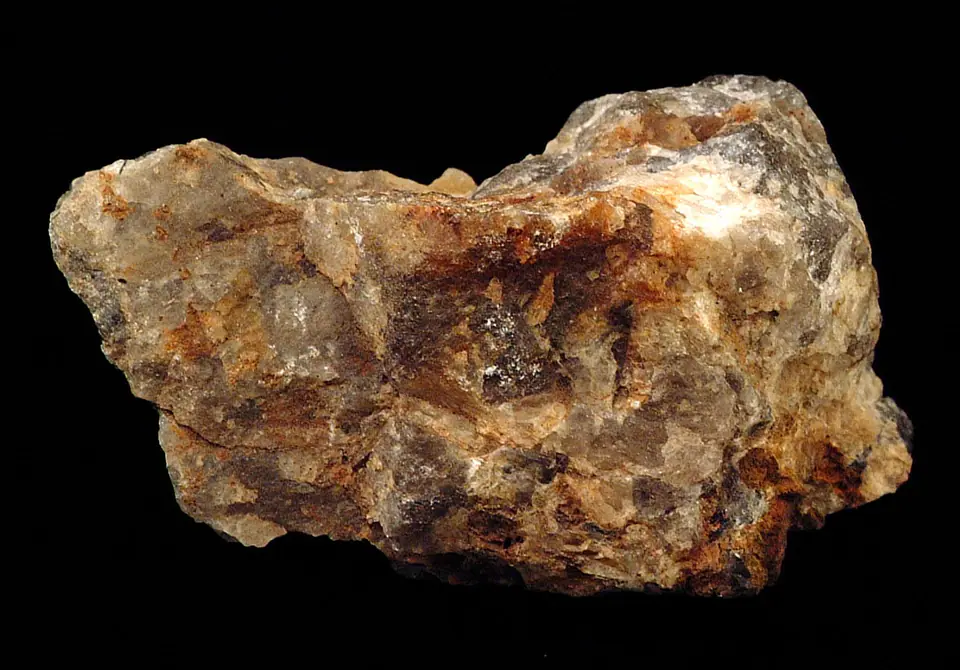

What is zircon?
Zircon is ZrSiO₄ and commonly contains small amounts of hafnium, uranium, thorium, rare-earth elements, and other substitutions. Radiation damage accumulated over geologic time can reduce hardness, density, transparency, and crystal order.
What does zircon look like?
Well-formed crystals are short to elongate four-sided prisms with pyramidal ends. Grains may be colorless, honey-brown, reddish, yellow, green, or nearly black, with vitreous to adamantine luster.
Many zircons occur only as tiny rounded sand grains or microscopic accessory crystals. Heated gem zircon and cubic zirconia are different identification problems and should not be confused with ordinary field material.
Identification tests
Begin with observation and use the least destructive test first. Results can change with weathering, mixtures, coatings, and grain size. Review the step-by-step field-test methods before altering an unfamiliar specimen.
Hardness
About 7.5 when crystalline and unalteredHarder than glass and monazite, but metamict material may be softer.
Density
High; commonly about 4.6 to 4.7Much denser than quartz and typically denser than diamond.
Habit
Tetragonal prisms and pyramidsFour-sided symmetry separates many intact crystals from quartz.
Streak
WhiteExpected but not distinctive for small hard grains.
Useful procedures: Mohs hardness test · Specific gravity and density test · Mineral streak test
Common lookalikes
Diamond
Harder at Mohs 10, has perfect octahedral cleavage, lower density, and different crystal forms and optical properties.
Quartz
Lower density, hexagonal crystal habit, and hardness near 7.
Monazite
Softer, commonly resinous and yellow-brown, and generally lacks zircon’s tetragonal prismatic symmetry.
How does it form?
Zircon crystallizes as an accessory mineral in many igneous rocks, especially silica-rich magmas, and survives metamorphism and sedimentary recycling.
Its durability and density concentrate it in heavy-mineral sands with rutile, ilmenite, monazite, garnet, and magnetite. Zircon crystals preserve uranium-lead isotopic systems widely used to determine rock ages.
Geologic setting and occurrence
Zircon is nearly ubiquitous in small amounts in igneous, metamorphic, and sedimentary rocks and can become concentrated in river and beach sands.
A sparkling sand grain cannot be identified reliably without magnification, density or optical work, and sometimes instrumental analysis.
Uses and significance
Zircon is the principal source of zirconium and hafnium and is used in ceramics, foundry sands, refractories, zirconium chemicals, nuclear applications, geochronology, and as a natural gemstone.
Field notes
- Do not confuse natural zircon with manufactured cubic zirconia.
- Avoid destructive testing of transparent crystals or gems.
- Some zircon and zircon-rich concentrates contain uranium and thorium; avoid dust, prolonged close storage of bulk material, and casual radiation claims without measurement.
This guide supports preliminary field identification, not a laboratory determination, appraisal, hazard assessment, or statement of ownership or collecting permission. Verify land status and local rules before handling or collecting material.
Authoritative sources
LithoMap wrote this guide in original language using the scientific concepts and physical-property standards supported by these sources.
- Zirconium and Hafnium Statistics and Information U.S. Geological Survey
- Minerals and their physical properties U.S. National Park Service
- Mohs Hardness Scale U.S. National Park Service
- Natural Gemstones: Mineral Gemstones U.S. Geological Survey
Editorial review: September 17, 2026.