
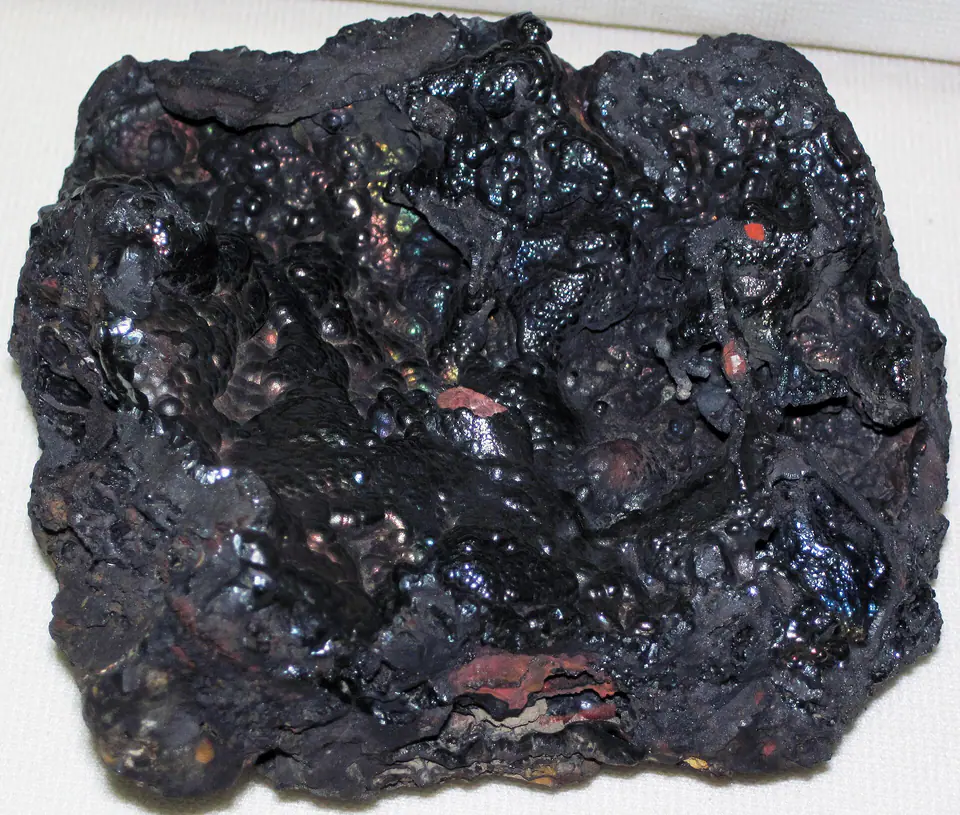

What is hematite?
Hematite is ferric iron oxide. Mixtures with clay, silica, goethite, magnetite, or other minerals alter hardness, luster, density, and magnetic response.
What does hematite look like?
Hematite occurs as steel-gray plates, shiny botryoidal masses, earthy red pigment, oolitic grains, and dense iron ore. Crystal form alone is therefore unreliable.
Weathering may create earthy coatings on other rocks. A coating can leave a red streak without the whole specimen being massive hematite.
Identification tests
Begin with observation and use the least destructive test first. Results can change with weathering, mixtures, coatings, and grain size. Review the step-by-step field-test methods before altering an unfamiliar specimen.
Streak
Red to reddish-brownThe most useful field test across metallic and earthy varieties.
Hardness
Variable, commonly about 5 to 6.5Earthy aggregates may be much softer than crystals.
Magnetism
Usually weak or absentStrong attraction suggests magnetite or a mixture.
Density
Dense when massive and relatively pureClay-rich earthy material may feel lighter.
Useful procedures: Mineral streak test · Mohs hardness test · Mineral magnetism test · Specific gravity and density test
Common lookalikes
How does it form?
Hematite forms in oxidizing sedimentary, hydrothermal, volcanic, metamorphic, and weathering environments.
It is abundant in banded iron formations and can replace or develop from other iron minerals during oxidation.
Geologic setting and occurrence
Hematite occurs in iron formations, red beds, hydrothermal deposits, volcanic rocks, soils, and weathered zones.
A red-streaking coating may be thin and secondary. Examine a fresh interior before calling an entire specimen hematite-rich.
Uses and significance
Hematite is a principal iron ore and has long been used as red pigment. Specular varieties are also collected and used decoratively.
Field notes
- Use an unglazed streak plate; color on skin or paper is less controlled.
- Avoid breathing iron-rich mine dust.
- Dense iron oxide is not a meteorite merely because it attracts a magnet weakly.
This guide supports preliminary field identification, not a laboratory determination, appraisal, hazard assessment, or statement of ownership or collecting permission. Verify land status and local rules before handling or collecting material.
Authoritative sources
LithoMap wrote this guide in original language using the scientific concepts and physical-property standards supported by these sources.
- Minerals and their physical properties U.S. National Park Service
- Mohs Hardness Scale U.S. National Park Service
- Natural Gemstones: Mineral Gemstones U.S. Geological Survey
Editorial review: September 17, 2026.