
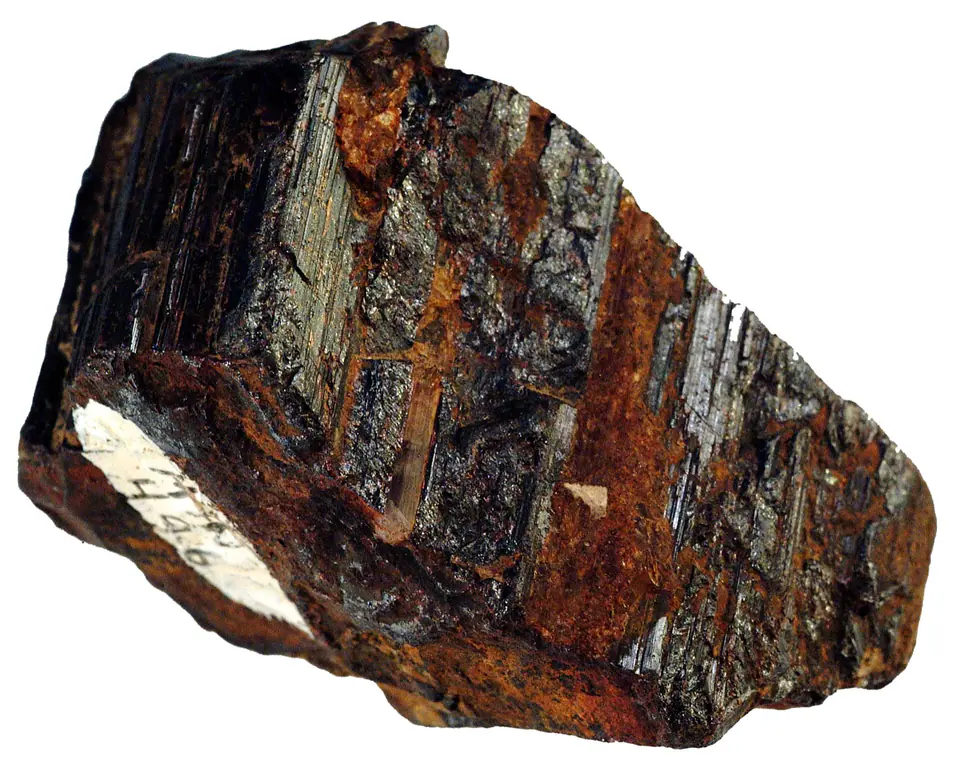

What is rutile?
Rutile is the most common natural polymorph of TiO₂. Iron, niobium, tantalum, tin, and other elements may substitute in natural crystals, changing color, density, magnetism, and opacity.
What does rutile look like?
Crystals are commonly tetragonal prisms with strong grooves parallel to their length, often terminated by pyramidal faces. Rutile also occurs as compact masses, granular material, and hairlike inclusions in quartz.
Colors range from red and reddish brown to dark brown, black, yellow, or golden. Metallic, adamantine, or submetallic luster can make dark rutile resemble iron oxides or sulfides.
Identification tests
Begin with observation and use the least destructive test first. Results can change with weathering, mixtures, coatings, and grain size. Review the step-by-step field-test methods before altering an unfamiliar specimen.
Hardness
About 6 to 6.5Harder than hematite and much harder than sphalerite.
Streak
Pale brown to yellowish brownDiffers from hematite’s red-brown streak and magnetite’s black streak.
Habit
Striated tetragonal prisms, needles, or compact massesLengthwise grooves and angular prisms support rutile.
Density
High; commonly around 4.2 to 4.3A useful supporting clue in clean, matrix-free material.
Useful procedures: Mohs hardness test · Mineral streak test · Specific gravity and density test
Common lookalikes
Hematite
Typically leaves a red to reddish-brown streak and lacks rutile’s common tetragonal prismatic habit.
Cassiterite
Usually still denser, commonly leaves a white to pale streak, and often forms short bipyramidal crystals.
Tourmaline
Commonly has a triangular cross section, poor cleavage, lower density, and a white streak.
How does it form?
Rutile forms as an accessory mineral in igneous and metamorphic rocks and in hydrothermal veins. It is especially persistent in high-grade metamorphic rocks and some altered titanium-bearing minerals.
Its high density and resistance to weathering allow grains to accumulate with ilmenite, zircon, monazite, and magnetite in stream or coastal placer sands.
Geologic setting and occurrence
Rutile occurs in metamorphic and igneous terrains, pegmatites, veins, and heavy-mineral sands. Well-formed U.S. crystals are known from localities including Graves Mountain, Georgia, and parts of the Appalachians.
Black sand is normally a mixture; color and magnetic separation alone cannot prove that a particular grain is rutile.
Uses and significance
Rutile is an important titanium mineral and feedstock for titanium dioxide pigment and titanium metal. Transparent or included crystals are also used as gems and collector specimens.
Field notes
- Do not identify dark sand grains by color alone.
- Avoid grinding titanium-bearing concentrates or unknown mine material.
- Preserve intact crystals and gem material by using nondestructive tests first.
This guide supports preliminary field identification, not a laboratory determination, appraisal, hazard assessment, or statement of ownership or collecting permission. Verify land status and local rules before handling or collecting material.
Authoritative sources
LithoMap wrote this guide in original language using the scientific concepts and physical-property standards supported by these sources.
- Titanium Statistics and Information U.S. Geological Survey
- Mineral Commodity Summaries: Titanium Mineral Concentrates U.S. Geological Survey
- Minerals and their physical properties U.S. National Park Service
- Mohs Hardness Scale U.S. National Park Service
- Natural Gemstones: Mineral Gemstones U.S. Geological Survey
Editorial review: September 17, 2026.