
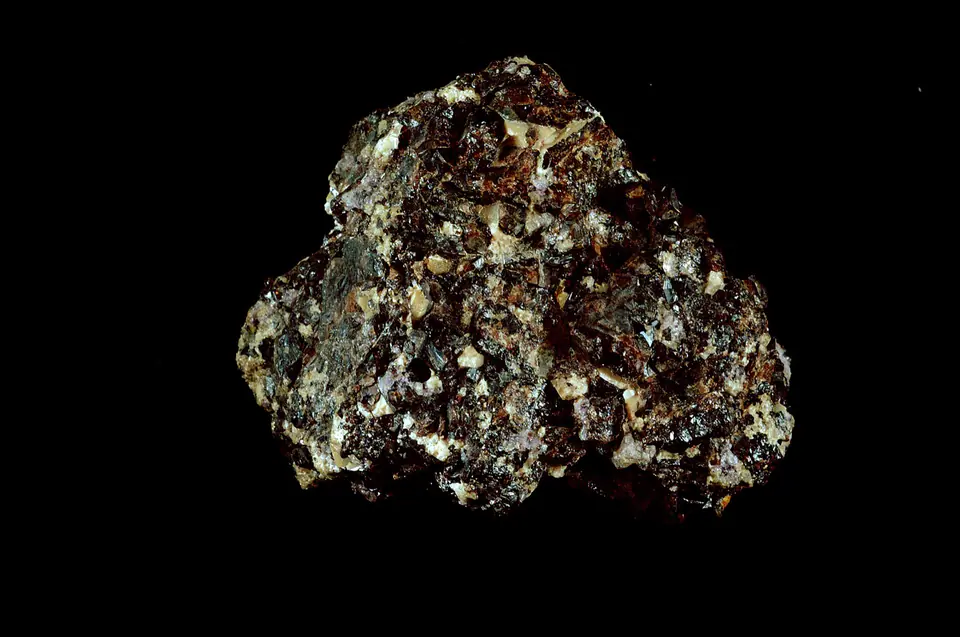

What is cassiterite?
Cassiterite is SnO₂. Iron, tantalum, niobium, tungsten, and other substitutions or inclusions can darken specimens and modify density, luster, and magnetic response.
What does cassiterite look like?
Crystals commonly form short tetragonal prisms capped by pyramids, and cyclic or elbow-like twins are frequent. Luster ranges from adamantine on crystal faces to greasy or submetallic in dark masses.
Stream-worn “wood tin” and placer grains may be rounded, banded, or botryoidal and can resemble dark garnet, rutile, iron oxides, or industrial slag.
Identification tests
Begin with observation and use the least destructive test first. Results can change with weathering, mixtures, coatings, and grain size. Review the step-by-step field-test methods before altering an unfamiliar specimen.
Density
Very high; commonly about 6.8 to 7.1One of the strongest clues when measured on clean material.
Hardness
About 6 to 7Harder than sphalerite and many dark metallic-looking minerals.
Streak
White to pale brownDiffers from the dark or colored streaks of many iron and sulfide lookalikes.
Magnetism
Normally not strongly magneticStrong attraction suggests magnetite or attached magnetic minerals.
Useful procedures: Specific gravity and density test · Mohs hardness test · Mineral streak test · Mineral magnetism test
Common lookalikes
Sphalerite
Much softer, has prominent multidirectional cleavage, and commonly leaves a pale brown to yellow streak.
Rutile
Generally less dense and more often elongate and strongly striated; streak is commonly pale brown.
Magnetite
Strongly magnetic, black-streaking, and usually less dense.
How does it form?
Cassiterite forms in granitic pegmatites, high-temperature hydrothermal veins, greisens, skarns, and related granite-centered mineral systems.
Its exceptional density, hardness, and chemical resistance allow it to survive erosion and accumulate in stream placers, where much historical tin production originated.
Geologic setting and occurrence
Cassiterite occurs in granite-related mineral districts and placer deposits. U.S. occurrences are scattered, but appearance alone cannot establish economic tin grade or lawful collecting access.
Concentrates may contain wolframite, arsenopyrite, sulfides, uranium-bearing minerals, or other dense phases requiring careful handling and analysis.
Uses and significance
Cassiterite is the principal ore mineral of tin. Tin is used in solder, coatings, bronze and other alloys, chemicals, glass, and specialized electronics and energy applications.
Field notes
- Compare measured mass and volume rather than subjective heft when possible.
- Do not grind ore or placer concentrate.
- Historic mine dumps may contain unstable workings and toxic metal or arsenic contamination.
This guide supports preliminary field identification, not a laboratory determination, appraisal, hazard assessment, or statement of ownership or collecting permission. Verify land status and local rules before handling or collecting material.
Authoritative sources
LithoMap wrote this guide in original language using the scientific concepts and physical-property standards supported by these sources.
- Tin Statistics and Information U.S. Geological Survey
- Minerals and their physical properties U.S. National Park Service
- Mohs Hardness Scale U.S. National Park Service
- Natural Gemstones: Mineral Gemstones U.S. Geological Survey
Editorial review: September 17, 2026.