
.jpg)
What is rhyolite?
Rhyolite is rich in silica and generally contains feldspar and quartz with smaller amounts of darker minerals. Its fine groundmass can conceal most of those minerals from unaided view.
What does rhyolite look like?
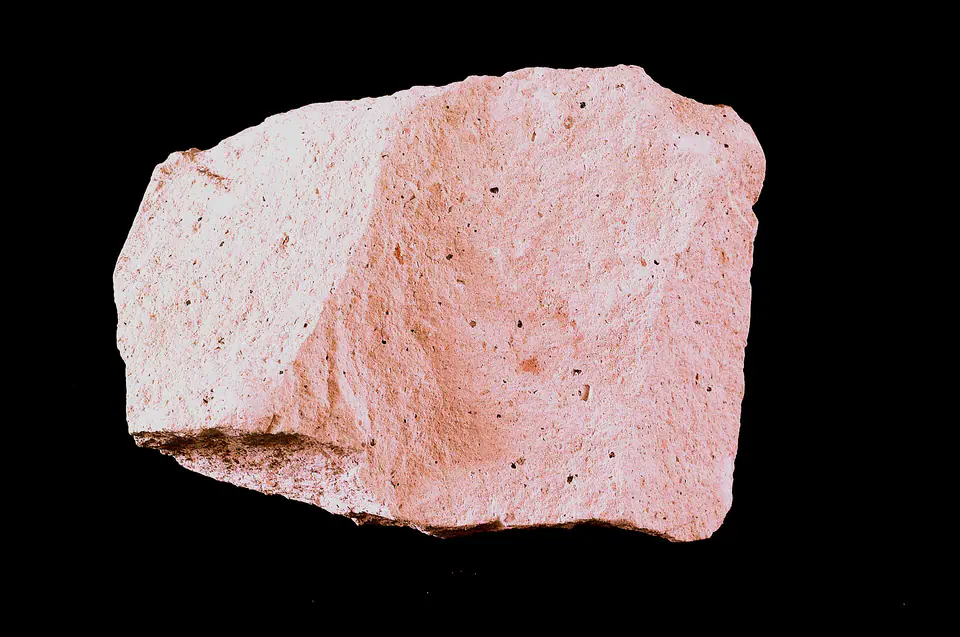
Many rhyolites are dense and pale, with scattered larger crystals in a much finer matrix. Flow bands can appear as parallel or folded color streaks.
Weathering, vapor-phase alteration, and devitrification may create mottled, porous, or chalky surfaces that obscure the original volcanic texture.
Identification tests
Begin with observation and use the least destructive test first. Results can change with weathering, mixtures, coatings, and grain size. Review the step-by-step field-test methods before altering an unfamiliar specimen.
Texture
Fine groundmass, sometimes with quartz or feldspar phenocrystsSupports an extrusive felsic rock rather than coarse granite.
Hardness
Commonly scratches glass where fresh and silica-richSoftness may reflect alteration rather than original composition.
Acid
No broad reactionLocalized fizz may come from secondary carbonate in cavities or fractures.
Useful procedures: Mohs hardness test · Acid reaction test
Common lookalikes
Felsite
A field term for light fine-grained felsic rock; more precise naming may require microscopy or chemistry.
Welded tuff
May contain flattened pumice fragments, shards, or fragmental textures rather than a wholly coherent lava fabric.
Quartzite
Shows a granular mosaic of recrystallized quartz and lacks volcanic flow textures or phenocrysts.
How does it form?
Rhyolite forms from viscous, silica-rich magma erupted as lava, domes, or related volcanic material. Its high viscosity can trap gas and contribute to explosive activity.
A rock described broadly as rhyolitic may be a coherent lava, welded ash-flow deposit, or altered volcanic rock. Field relationships are needed to distinguish these origins.
Geologic setting and occurrence
Rhyolite occurs in continental volcanic fields, caldera systems, lava domes, and ash-flow provinces across the western United States and elsewhere.
Because alteration changes color and texture, a mapped volcanic unit and local stratigraphic description are often more reliable than color alone.
Uses and significance
Dense rhyolite has been used locally as building stone and aggregate. Attractive banded or orbicular material may be cut as lapidary stone where lawful.
Field notes
- Do not use color as the sole criterion.
- Freshly broken silica-rich rock can make razor-sharp edges.
- Hydrothermally altered volcanic ground can contain unstable slopes, hot areas, or hazardous minerals.
This guide supports preliminary field identification, not a laboratory determination, appraisal, hazard assessment, or statement of ownership or collecting permission. Verify land status and local rules before handling or collecting material.
Authoritative sources
LithoMap wrote this guide in original language using the scientific concepts and physical-property standards supported by these sources.
- Igneous Rocks U.S. National Park Service
- How Rocks Are Classified U.S. National Park Service
- Rocks and Minerals U.S. National Park Service
- What is the difference between a rock and a mineral? U.S. Geological Survey
Editorial review: September 17, 2026.