
.jpg)
What is quartzite?
Quartz dominates true quartzite. Mica, feldspar, iron oxides, or other impurities can create color and weak layering. The commercial stone trade sometimes calls hard, silica-cemented sandstone quartzite.
What does quartzite look like?
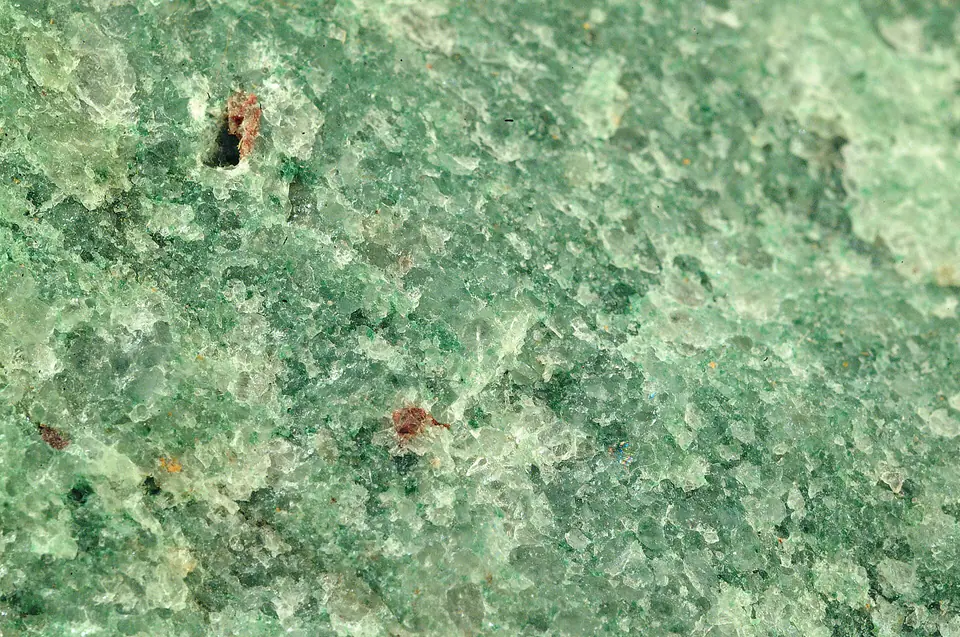
Fresh quartzite can look granular, but grain boundaries are fused. A fracture tends to cut across former sand grains instead of following cement between them.
Some quartzite preserves bedding, cross-bedding, or stretched sedimentary structures. More intense deformation may create lineation or minor foliation.
Identification tests
Begin with observation and use the least destructive test first. Results can change with weathering, mixtures, coatings, and grain size. Review the step-by-step field-test methods before altering an unfamiliar specimen.
Hardness
Scratches glass easilyExpected because quartz has Mohs hardness 7.
Fracture
Breaks across fused grainsSeparates quartzite from sandstone, which commonly breaks around grains.
Acid
No reactionSeparates quartzite from marble and most carbonate rocks.
Useful procedures: Mohs hardness test · Cleavage versus fracture · Acid reaction test
Common lookalikes
How does it form?
Quartzite forms when quartz-rich sandstone is heated and compressed during contact or regional metamorphism. Quartz dissolves and recrystallizes along grain boundaries.
The resulting network is usually denser and stronger than the original sandstone, although impurities and fractures can weaken it.
Geologic setting and occurrence
Quartzite forms resistant ridges and peaks in metamorphic belts and around intrusions. Quartz-rich cobbles can travel far downstream or within glacial deposits.
Hard silica-cemented sandstone can be difficult to separate from lightly metamorphosed quartzite in the field; thin-section evidence may be needed.
Uses and significance
Quartzite is used for dimension stone, aggregate, decorative stone, and silica-rich industrial material where composition and purity are suitable.
Field notes
- Fresh fracture edges can be sharp and splinters can travel when struck.
- Do not call every hard white rock quartzite; check texture and acid reaction.
- Resistant cliffs and talus slopes can be unstable.
This guide supports preliminary field identification, not a laboratory determination, appraisal, hazard assessment, or statement of ownership or collecting permission. Verify land status and local rules before handling or collecting material.
Authoritative sources
LithoMap wrote this guide in original language using the scientific concepts and physical-property standards supported by these sources.
- How Rocks Are Classified U.S. National Park Service
- Rocks and Minerals U.S. National Park Service
- What is the difference between a rock and a mineral? U.S. Geological Survey
Editorial review: September 17, 2026.