
.jpg)
What is sandstone?
Quartz is common because it resists weathering, but sandstone may also contain feldspar, rock fragments, mica, clay, iron oxides, or carbonate cement. Composition controls color and durability.
What does sandstone look like?
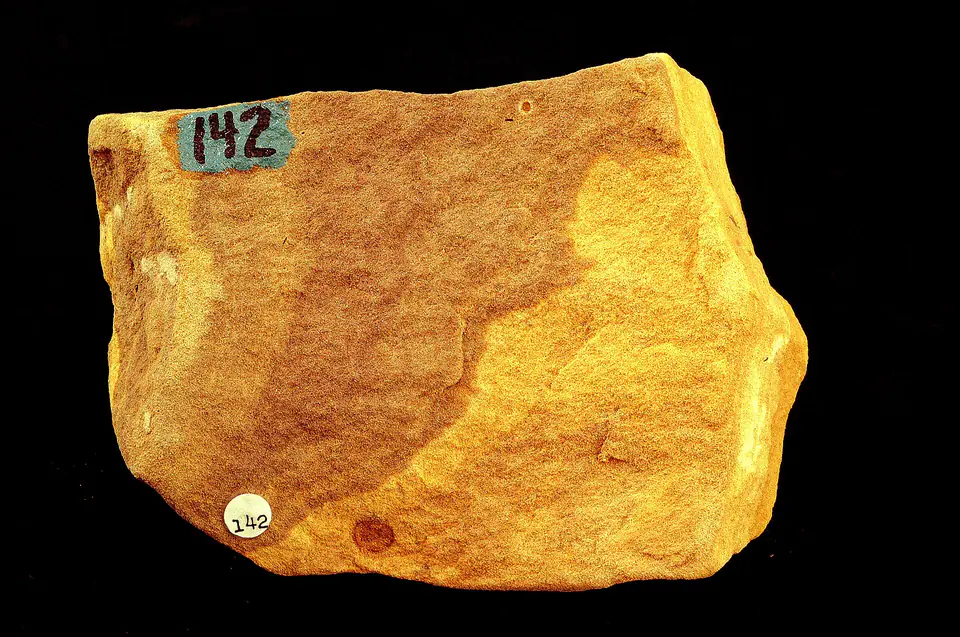
Individual grains may be rounded or angular and well sorted or mixed in size. Cement fills spaces between grains rather than forming a completely interlocking crystalline mosaic.
Layering can range from thin laminae to thick beds. Cross-beds, ripples, burrows, and other structures may record dunes, rivers, beaches, or marine settings.
Identification tests
Begin with observation and use the least destructive test first. Results can change with weathering, mixtures, coatings, and grain size. Review the step-by-step field-test methods before altering an unfamiliar specimen.
Texture
Sand-size grains can be seen or feltSeparates sandstone from very fine shale and from interlocking quartzite.
Hardness
Quartz grains scratch glass; the cement may be softerLoose grains after scratching can reveal weak cement.
Acid
Variable; carbonate-cemented sandstone may fizzReaction identifies cement or carbonate grains, not the grain-size class by itself.
Useful procedures: Mohs hardness test · Acid reaction test
Common lookalikes
How does it form?
Sand accumulates where water, wind, ice, or gravity transports and deposits sediment. Burial compacts the grains, while minerals precipitating from groundwater cement them into rock.
The word sandstone describes grain size, not one environment. Similar-looking samples can have very different ages, origins, and formal formation names.
Geologic setting and occurrence
Sandstone is widespread in sedimentary basins and exposed plateaus, cliffs, ridges, and canyon walls. It may alternate with shale, conglomerate, limestone, or volcanic layers.
Porosity, cement, fractures, and weathering vary greatly even within one bed, so hand-sample strength does not establish engineering behavior.
Uses and significance
Durable sandstone is used as dimension stone, flagstone, and aggregate. Porous sandstone can also host groundwater, petroleum, natural gas, or mineralization.
Field notes
- Observe bed geometry and sedimentary structures before removing a sample.
- Cliff-forming sandstone can shed blocks without warning.
- A sandstone outcrop does not imply a legal source of collectible material.
This guide supports preliminary field identification, not a laboratory determination, appraisal, hazard assessment, or statement of ownership or collecting permission. Verify land status and local rules before handling or collecting material.
Authoritative sources
LithoMap wrote this guide in original language using the scientific concepts and physical-property standards supported by these sources.
- How Rocks Are Classified U.S. National Park Service
- Rocks and Minerals U.S. National Park Service
- What is the difference between a rock and a mineral? U.S. Geological Survey
Editorial review: September 17, 2026.