
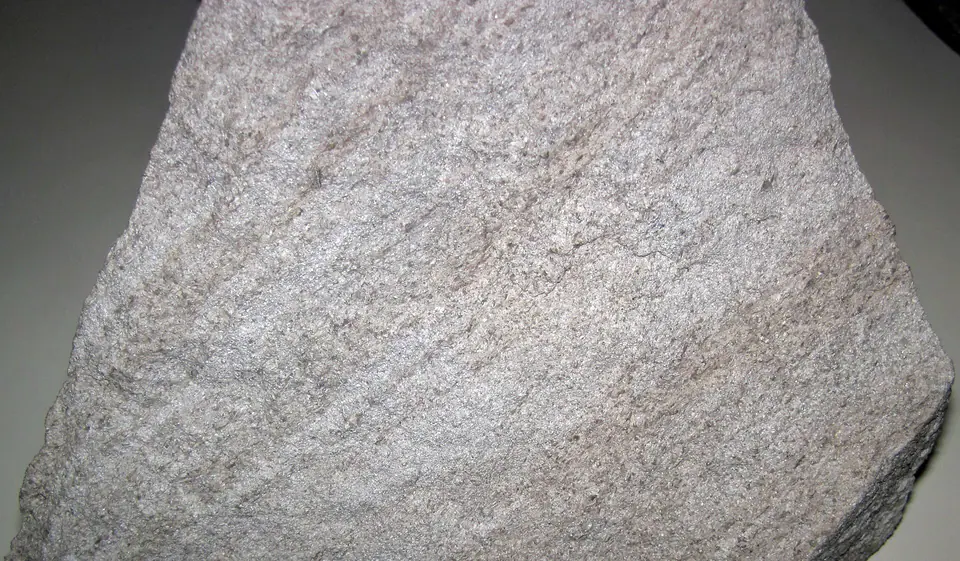
.jpg)
What is limestone?
Most limestone is dominated by calcite. Dolomite, clay, quartz, organic matter, iron oxides, and fossils may be present, producing wide variation in color and response to tests.
What does limestone look like?
Limestone ranges from dense, fine-grained micrite to coarse shell beds and crystalline material. Bedding may be obvious, massive, nodular, or disrupted by burrows.
Solution along fractures creates pits, enlarged joints, caves, sinkholes, and other karst features. Weathered surfaces may look rough and pale even when fresh interiors are darker.
Identification tests
Begin with observation and use the least destructive test first. Results can change with weathering, mixtures, coatings, and grain size. Review the step-by-step field-test methods before altering an unfamiliar specimen.
Acid
Fresh calcite-rich surface effervesces with dilute acidA strong field clue; use controlled safety practices and avoid protected surfaces.
Hardness
Calcite-rich material is about Mohs 3Often scratched by a steel point, unlike quartz-rich sandstone.
Texture
May show fossils, pellets, ooids, mud, or crystalline calciteTexture helps refine the limestone type but can vary within one unit.
Useful procedures: Acid reaction test · Mohs hardness test
Common lookalikes
Dolostone
Usually reacts weakly unless powdered; composed largely of dolomite rather than calcite.
Marble
Has a recrystallized mosaic that commonly destroys original sedimentary textures and fossils.
Calcareous sandstone
Contains evident sand grains even though carbonate cement may fizz.
How does it form?
Many limestones form in marine settings where carbonate mud, skeletal material, or chemically precipitated grains accumulate. Others form in lakes, springs, caves, or soils.
Burial compacts, cements, and recrystallizes carbonate sediment. Later groundwater can dissolve and redeposit calcite in veins or cavities.
Geologic setting and occurrence
Limestone is widespread in sedimentary basins, former continental shelves, reef systems, and karst regions across the United States.
Fossils may be common, rare, dissolved, or absent. A limestone identification never guarantees collectible fossils at a particular place.
Uses and significance
Limestone is a major source of aggregate, cement and lime, agricultural material, building stone, and industrial calcium carbonate. It can also be an important aquifer rock.
Field notes
- Use acid only with eye protection and permission; vinegar gives a weaker, safer response.
- Sinkholes, caves, mines, and quarry walls present severe hazards.
- Do not collect fossils or cave formations without explicit legal authorization.
This guide supports preliminary field identification, not a laboratory determination, appraisal, hazard assessment, or statement of ownership or collecting permission. Verify land status and local rules before handling or collecting material.
Authoritative sources
LithoMap wrote this guide in original language using the scientific concepts and physical-property standards supported by these sources.
- How Rocks Are Classified U.S. National Park Service
- Rocks and Minerals U.S. National Park Service
- What is the difference between a rock and a mineral? U.S. Geological Survey
Editorial review: September 17, 2026.