
.jpg)
What is chert?
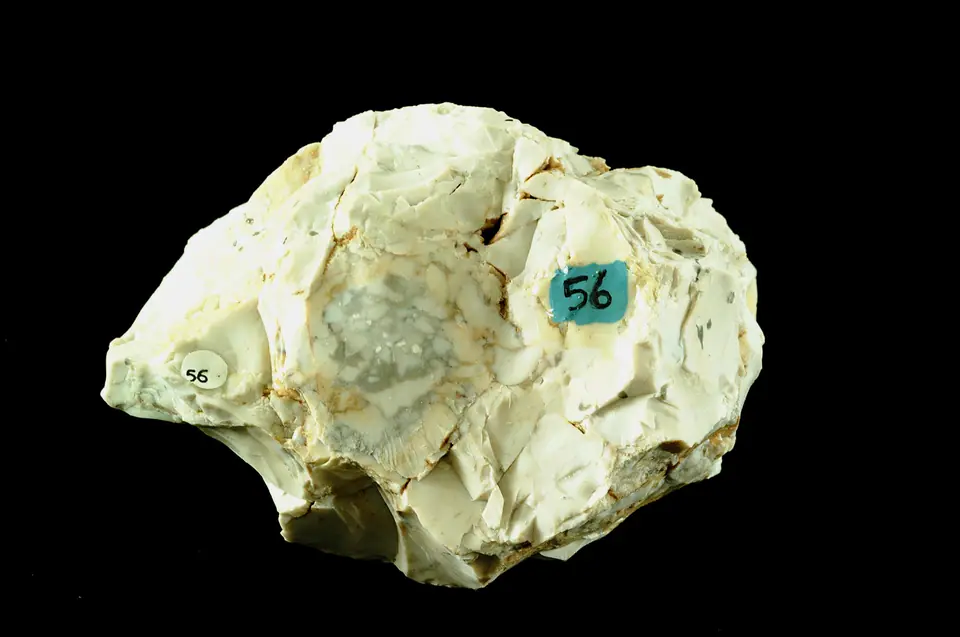
Chert consists mainly of extremely small quartz and related silica crystals. Iron oxides, organic matter, clay, and other impurities produce white, gray, tan, red, brown, green, or black varieties; color names do not establish origin.
What does chert look like?
Fresh chert commonly has a smooth waxy surface and concentric fracture ripples. Weathered rinds may be pale, chalky, or rough while the interior remains dense.
It occurs as nodules, lenses, or continuous beds. Fossil-rich varieties may contain microscopic radiolarians or sponge spicules, but magnification or laboratory work may be necessary.
Identification tests
Begin with observation and use the least destructive test first. Results can change with weathering, mixtures, coatings, and grain size. Review the step-by-step field-test methods before altering an unfamiliar specimen.
Hardness
Scratches ordinary glassSupports silica-rich chert and separates it from many carbonate nodules.
Fracture
Conchoidal with very sharp edgesA strong clue shared with obsidian and massive quartz.
Grain visibility
No individual sand grains visible to the unaided eyeSeparates chert from most quartz sandstone and many quartzites.
Useful procedures: Mohs hardness test · Cleavage versus fracture
Common lookalikes
Quartzite
Usually preserves a sugary or fused granular mosaic; chert is more uniformly microcrystalline and waxy.
Obsidian
Is true volcanic glass with a more vitreous luster and volcanic context.
Micritic limestone
Is softer and commonly reacts with dilute acid, while chert scratches glass and does not broadly fizz.
How does it form?
Chert forms when silica precipitates or reorganizes within sediment, commonly from silica supplied by microscopic organisms, volcanic material, or pore fluids.
Silica may replace carbonate or other material during diagenesis, so nodules can crosscut or preserve features of the host rock.
Geologic setting and occurrence
Chert is widespread in carbonate sequences, deep-marine sedimentary rocks, and silica-rich deposits. Durable fragments concentrate in stream gravels, soils, and glacial deposits.
Flint is a traditional name commonly applied to certain cherts, especially dark nodular material in chalk or limestone; usage varies by region.
Uses and significance
Chert was widely shaped into tools because it fractures predictably, and it is used locally as aggregate or decorative stone. Archaeological artifacts and flakes are protected cultural materials and must not be collected.
Field notes
- Fresh edges are razor sharp; wear eye protection and never test an edge with a finger.
- Do not disturb artifacts, flakes, quarries, or archaeological contexts.
- Use a fresh surface because weathered rinds can conceal texture and color.
This guide supports preliminary field identification, not a laboratory determination, appraisal, hazard assessment, or statement of ownership or collecting permission. Verify land status and local rules before handling or collecting material.
Authoritative sources
LithoMap wrote this guide in original language using the scientific concepts and physical-property standards supported by these sources.
- How Rocks Are Classified U.S. National Park Service
- Rocks and Minerals U.S. National Park Service
- What is the difference between a rock and a mineral? U.S. Geological Survey
Editorial review: September 17, 2026.