
.jpg)
What is amphibolite?
Typical amphibolite contains abundant hornblende or another amphibole with plagioclase. Garnet, quartz, epidote, biotite, pyroxene, or other minerals may occur depending on the parent rock and metamorphic conditions.
What does amphibolite look like?
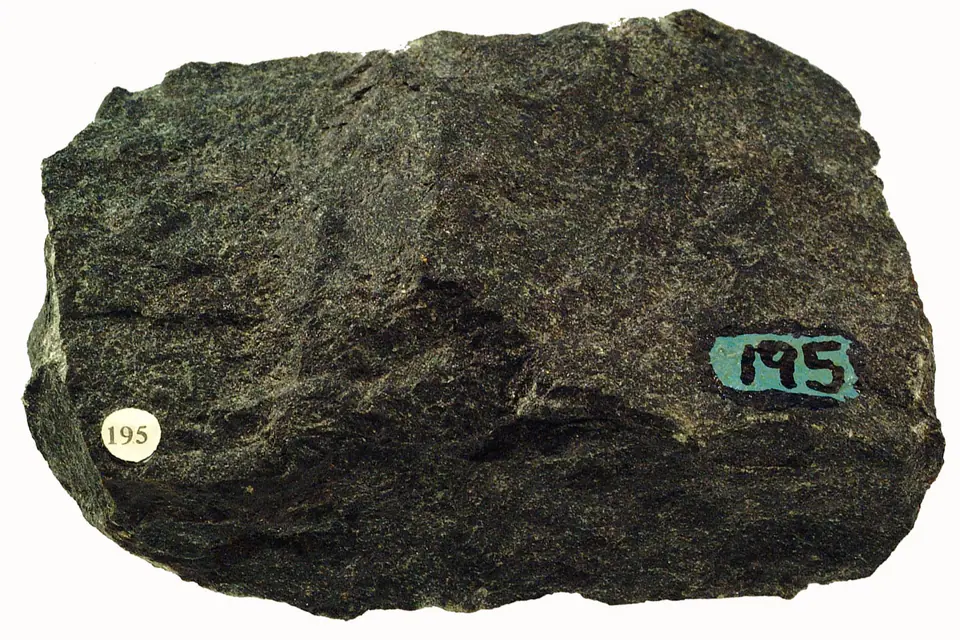
Fresh amphibolite is commonly dense and dark, with shiny elongate amphibole grains and intergrown pale feldspar. Foliated samples show aligned amphibole; massive samples can resemble gabbro.
Weathering may create rusty, brown, or green surfaces and can accentuate foliation or release resistant garnet grains.
Identification tests
Begin with observation and use the least destructive test first. Results can change with weathering, mixtures, coatings, and grain size. Review the step-by-step field-test methods before altering an unfamiliar specimen.
Mineral shape
Elongate dark amphibole with pale plagioclaseSupports amphibolite when the grains can be identified.
Fabric
Commonly aligned or foliated, but may be massiveFoliation separates many samples from igneous gabbro.
Hardness
Most fresh grains resist a steel point and may scratch glass unevenlyConsistent with amphibole and feldspar but not diagnostic alone.
Useful procedures: Mohs hardness test
Common lookalikes
Gabbro
Has an igneous interlocking texture without metamorphic mineral alignment, though massive amphibolite can be difficult.
Hornblende schist
A descriptive overlap may exist; strongly schistose amphibole-rich rock can receive either field description depending on classification.
Greenstone
Usually finer grained and lower grade, with chlorite, epidote, or actinolite alteration obscuring original mafic minerals.
How does it form?
Amphibolite commonly forms when basalt, gabbro, or related mafic rock recrystallizes under moderate to high metamorphic temperatures and pressures.
Some amphibolites have sedimentary or volcanic-sedimentary precursors, so texture alone does not prove one parent rock.
Geologic setting and occurrence
Amphibolite is common in metamorphic belts and ancient continental crust, occurring as layers, lenses, and transformed mafic intrusions or lava flows.
A dark metamorphic sample cannot be tied to a named unit or protolith without outcrop relationships, mapping, and sometimes petrography or geochemistry.
Uses and significance
Competent amphibolite is used locally as aggregate, dimension stone, and decorative stone. Foliation and weathered minerals influence engineering performance.
Field notes
- Inspect a fresh surface for amphibole shape and alignment.
- Do not assume every dark crystalline rock is gabbro or basalt.
- Loose blocks and foliation surfaces can fail on steep slopes.
This guide supports preliminary field identification, not a laboratory determination, appraisal, hazard assessment, or statement of ownership or collecting permission. Verify land status and local rules before handling or collecting material.
Authoritative sources
LithoMap wrote this guide in original language using the scientific concepts and physical-property standards supported by these sources.
- Metamorphic Rocks U.S. National Park Service
- How Rocks Are Classified U.S. National Park Service
- Rocks and Minerals U.S. National Park Service
- What is the difference between a rock and a mineral? U.S. Geological Survey
Editorial review: September 17, 2026.