
.jpg)
What is basalt?
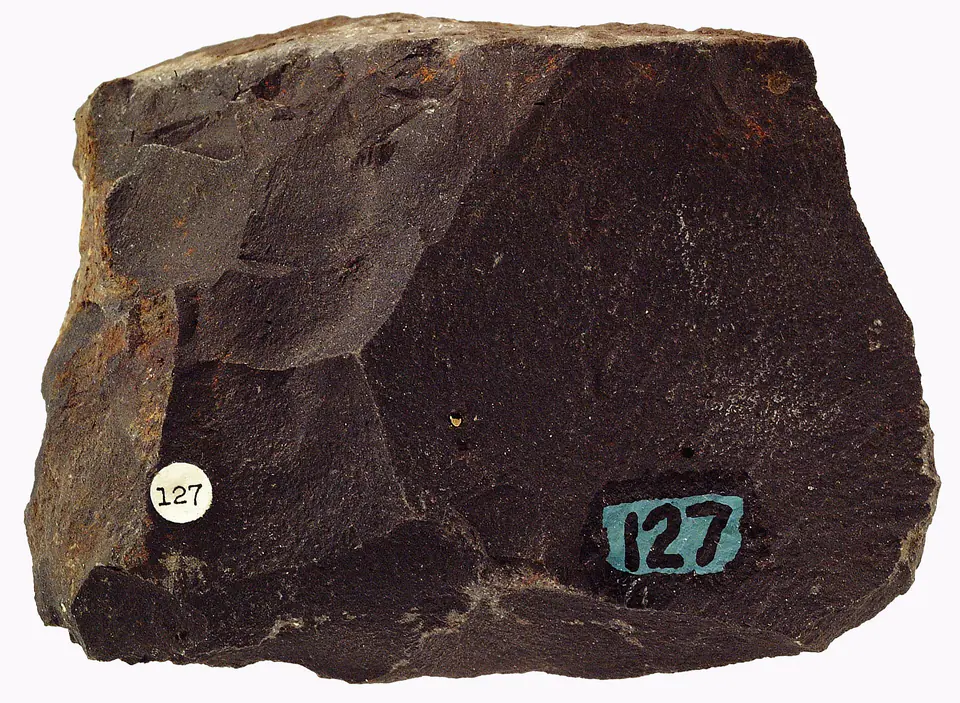
Basalt is a mafic volcanic rock composed chiefly of microscopic plagioclase and pyroxene, commonly with olivine and iron-titanium oxides. Weathering can turn surfaces brown, rusty, greenish, or reddish.
What does basalt look like?
Most basalt looks uniform at arm’s length because its crystals cooled too quickly to become large. Some pieces contain visible olivine or plagioclase crystals set in a fine matrix.
Vesicular basalt preserves bubbles from escaping volcanic gas. Later minerals may fill those cavities, producing amygdules.
Identification tests
Begin with observation and use the least destructive test first. Results can change with weathering, mixtures, coatings, and grain size. Review the step-by-step field-test methods before altering an unfamiliar specimen.
Grain size
Crystals mostly microscopicDistinguishes basalt from coarse-grained gabbro.
Magnetism
Often weakly magnetic, but variableSupports an iron-bearing volcanic rock; magnetism alone is not diagnostic.
Streak
The rock itself usually does not make a useful mineral streakA strong red or black powder may indicate iron-rich alteration or a mineral-rich sample.
Useful procedures: Mineral magnetism test · Mineral streak test
Common lookalikes
Andesite
Often medium gray and compositionally intermediate; field boundaries can be ambiguous without chemistry.
Slag
Industrial slag may be glassier, unusually bubbly, locally metallic, or found with furnace debris.
Meteorite
Basalt commonly has vesicles and lacks a continuous fusion crust; magnetism does not make a rock a meteorite.
How does it form?
Basalt forms when mafic lava cools at or near the surface. It builds lava flows, volcanic cones, oceanic crust, dikes, and extensive volcanic plateaus.
Cooling contraction can produce columns or irregular joints. Fragmental basaltic deposits can form where lava interacts explosively with water or erupts as cinders.
Geologic setting and occurrence
Basalt is abundant in oceanic crust and volcanic provinces, including Hawaii, the Columbia River Basalt Group, and many western volcanic fields. Glaciers and rivers can transport basalt cobbles beyond their source.
A dark fine-grained rock is not automatically basalt. Andesite, dark sedimentary rock, hornfels, slag, and weathered intrusive rocks can look similar.
Uses and significance
Basalt is quarried for aggregate, road stone, railroad ballast, and some architectural applications. Melted basalt can also be manufactured into fiber and specialty products.
Field notes
- Use texture, geologic setting, and a fresh surface together.
- Treat cliffs, lava tubes, unstable talus, and recent volcanic terrain as serious hazards.
- Never enter closed volcanic areas or collect in national parks without authorization.
This guide supports preliminary field identification, not a laboratory determination, appraisal, hazard assessment, or statement of ownership or collecting permission. Verify land status and local rules before handling or collecting material.
Authoritative sources
LithoMap wrote this guide in original language using the scientific concepts and physical-property standards supported by these sources.
- Igneous Rocks U.S. National Park Service
- How Rocks Are Classified U.S. National Park Service
- Rocks and Minerals U.S. National Park Service
- What is the difference between a rock and a mineral? U.S. Geological Survey
Editorial review: September 17, 2026.