
.jpg)
.jpg)
The most useful distinction
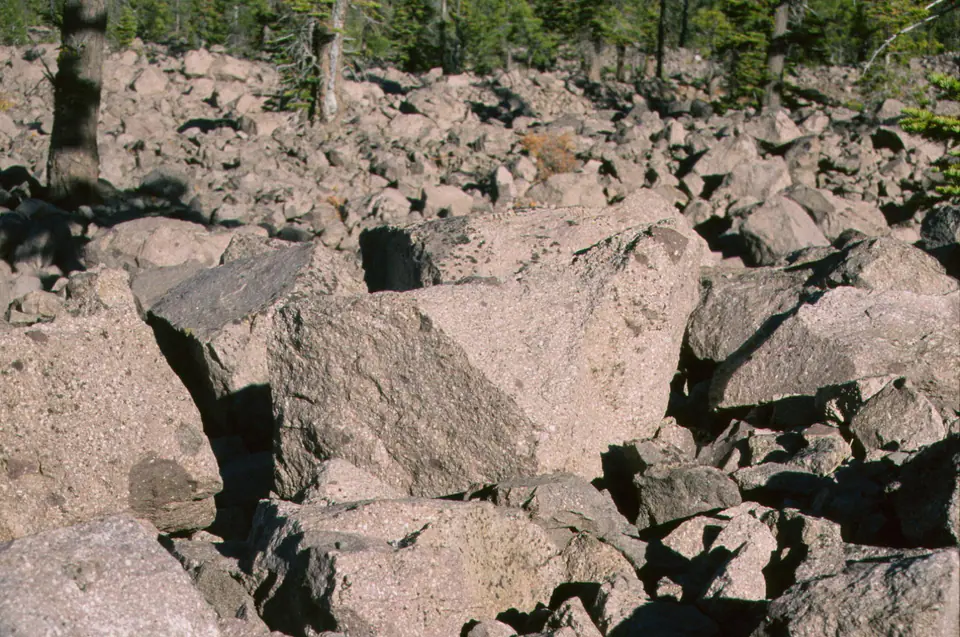
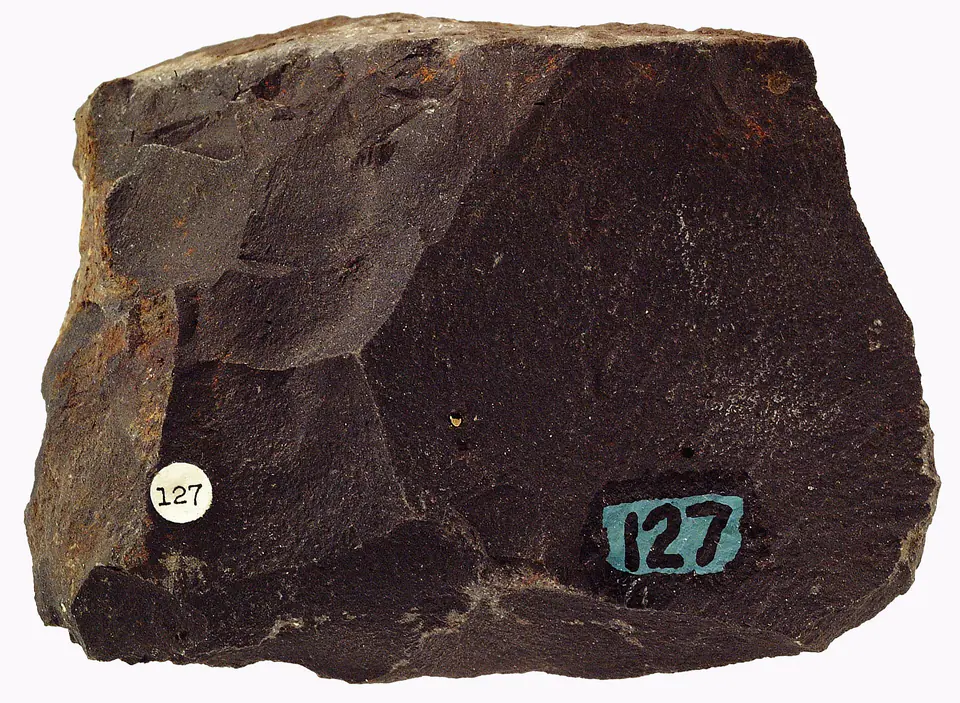
Treat color as a clue, not a verdict. A medium-gray rock with abundant pale plagioclase phenocrysts may be andesite, while a dark fine-grained or olivine-bearing rock may be basalt; borderline samples require chemistry.
Andesite and Basalt comparison table
| Property | Andesite | Basalt | How to use it |
|---|---|---|---|
| Composition | Intermediate silica and mafic-mineral content | Mafic, with lower silica and more iron- and magnesium-bearing minerals | Composition defines the distinction but is not always visible. |
| Typical color | Medium gray, sometimes reddish or altered | Dark gray to black when fresh | Useful for typical samples, unreliable for weathered or borderline rocks. |
| Phenocrysts | Pale plagioclase with possible amphibole or pyroxene is common | Plagioclase, pyroxene, or green olivine may occur | The phenocryst assemblage supports but rarely proves the name. |
| Magnetism | Variable and often weak | Often weakly magnetic, though highly variable | A magnet can support mafic character but cannot classify the rock. |
A practical identification sequence
- 1
Examine a fresh surface rather than the weathered rind.
- 2
Describe groundmass color separately from phenocrysts.
- 3
Identify any olivine, amphibole, pyroxene, or feldspar crystals cautiously.
- 4
Record the mapped volcanic unit and use chemistry when a precise boundary matters.
Where the distinction gets difficult
- Volcanic-rock names are formally separated by chemistry when crystals are too small to count.
- Oxidation and hydrothermal alteration can reverse the expected color contrast.
- Basaltic andesite occupies the compositional interval between typical basalt and andesite.
Use several independent observations. This comparison supports preliminary field identification, not laboratory confirmation, appraisal, proof of origin, or collecting permission.
Andesite vs. basalt FAQ
Is every gray lava andesite?
No. Basalt, dacite, rhyolite, welded tuff, and altered volcanic rocks can all be gray.
Can andesite be black?
Yes. Fresh, glassy, or mafic-rich andesite can be dark enough to resemble basalt.
Can I identify them with a magnet?
Not reliably. Magnetism varies within both and is supporting evidence only.
Authoritative sources
LithoMap wrote this comparison in original language from the physical properties and geological concepts supported by these public scientific references.
- Igneous Rocks U.S. National Park Service
- How Rocks Are Classified U.S. National Park Service
- Rocks and Minerals U.S. National Park Service
- What is the difference between a rock and a mineral? U.S. Geological Survey
Editorial review: September 17, 2026.