
.jpg)
.jpg)
The most useful distinction
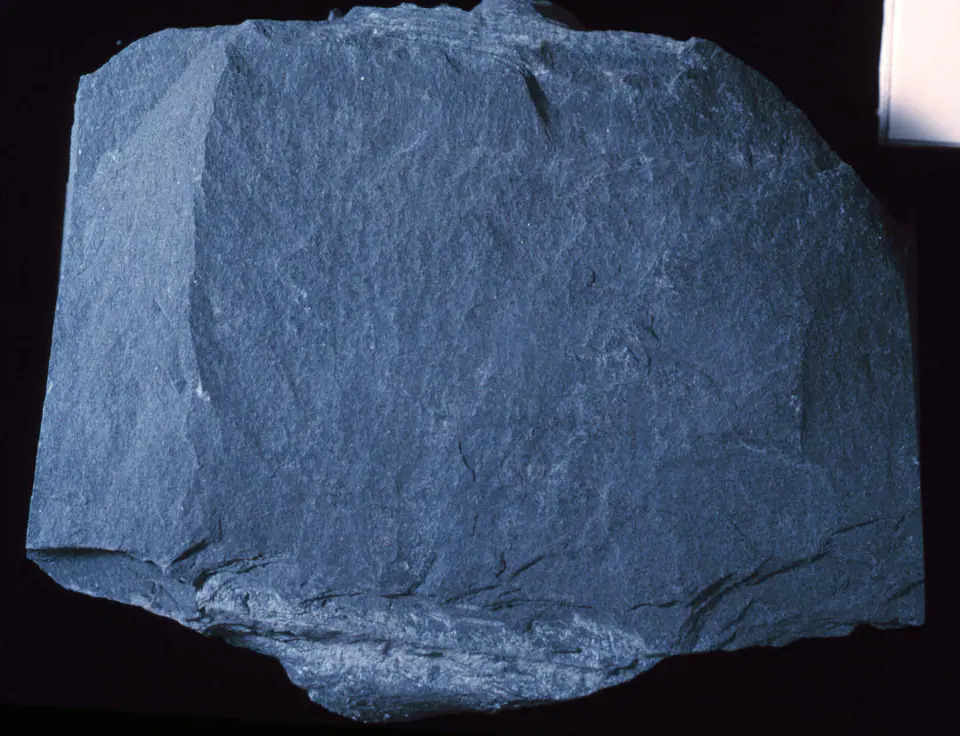
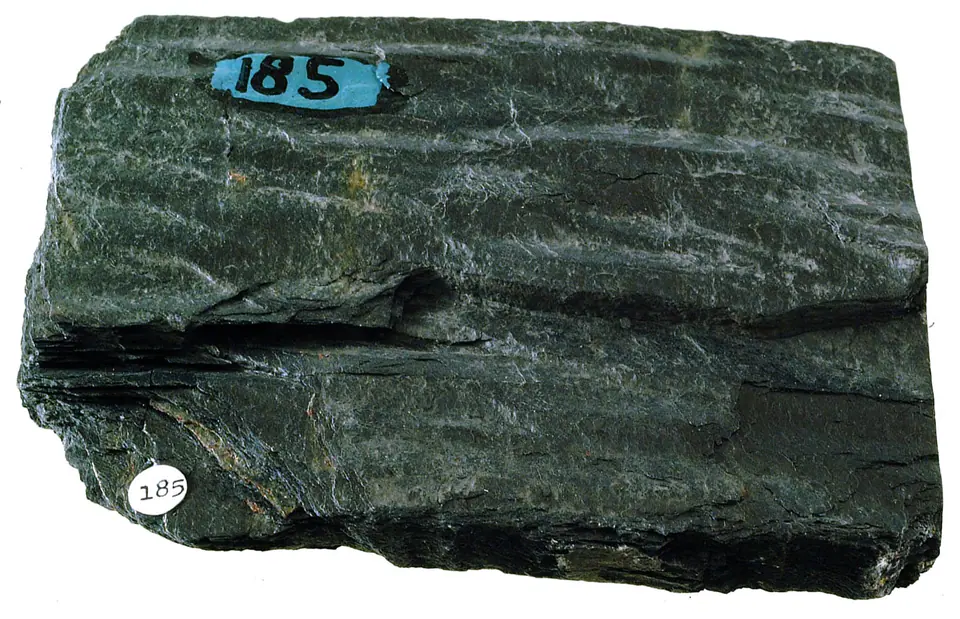
Rotate a fresh foliation surface in diffuse light. Flat, dull cleavage favors slate; a continuous silky reflection across wavy surfaces favors phyllite.
Slate and Phyllite comparison table
| Property | Slate | Phyllite | How to use it |
|---|---|---|---|
| Luster | Usually dull to subdued | Silky or satiny sheen | The most accessible field distinction. |
| Foliation shape | Closely spaced and commonly planar | Often wavy, crinkled, or gently corrugated | Reflects increasing recrystallization and deformation. |
| Grain size | Very fine; mica not visible unaided | Fine; mica generally still not individually visible | Both are fine grained, while schist is clearly coarser. |
| Metamorphic progression | Lower-grade texture derived commonly from shale or mudstone | Generally greater recrystallization between slate and schist | The boundary is gradual rather than a sharp universal line. |
A practical identification sequence
- 1
Clean a fresh foliation surface without polishing it.
- 2
Rotate it under diffuse light and observe whether sheen moves across the surface.
- 3
Compare flatness versus waviness of several cleavage surfaces.
- 4
Use “slaty phyllite” or note the transition when features are intermediate.
Where the distinction gets difficult
- Wet surfaces can make slate look deceptively shiny.
- Graphite, chlorite, or very fine mica can alter luster.
- Thin slabs have sharp edges and can be unstable on slopes.
Use several independent observations. This comparison supports preliminary field identification, not laboratory confirmation, appraisal, proof of origin, or collecting permission.
Slate vs. phyllite FAQ
Does phyllite contain visible mica?
Its mica is usually too small to identify individually, but collectively produces a silky sheen. Clearly visible flakes favor schist.
Can slate turn into phyllite?
With additional metamorphic recrystallization, slate can grade into phyllite and then schist.
Is every shiny slate phyllite?
No. Wetness, coatings, graphite, or lighting can add shine. Confirm a pervasive silky luster and commonly wavy foliation.
Authoritative sources
LithoMap wrote this comparison in original language from the physical properties and geological concepts supported by these public scientific references.
- How Rocks Are Classified U.S. National Park Service
- Rocks and Minerals U.S. National Park Service
- What is the difference between a rock and a mineral? U.S. Geological Survey
- Metamorphic Rocks U.S. National Park Service
Editorial review: September 17, 2026.