
.jpg)
What is slate?
Slate contains microscopic clay-derived mica, quartz, and other minerals. Carbon, chlorite, hematite, or other constituents can control color.
What does slate look like?
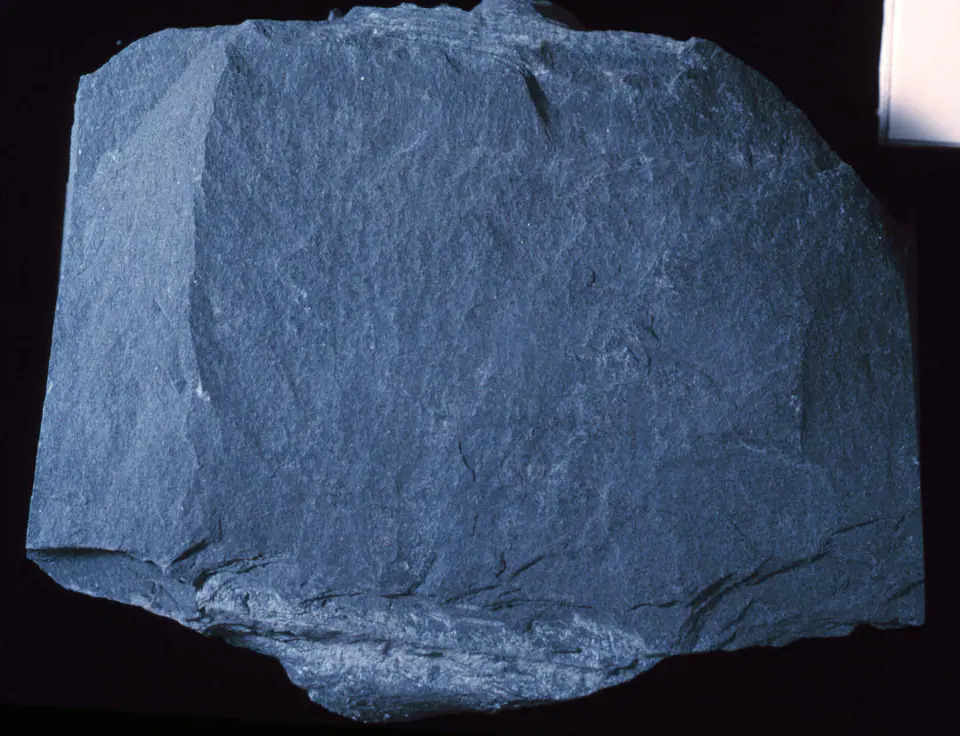
Fresh slate has smooth planar cleavage and may make a clear ringing sound compared with weathered shale. Bedding can survive as color bands that intersect the cleavage.
Wrinkles, tiny mineral spots, or later deformation may disrupt otherwise flat sheets. Weathering can cause iron staining or splitting along several surfaces.
Identification tests
Begin with observation and use the least destructive test first. Results can change with weathering, mixtures, coatings, and grain size. Review the step-by-step field-test methods before altering an unfamiliar specimen.
Cleavage
Regular, strong, closely spaced planar sheetsThe main field clue separating slate from ordinary shale.
Grain size
Microscopic or barely visiblePhyllite usually has a more obvious silky sheen and wavy foliation.
Hardness
Generally harder and more coherent than shaleWeathered slate can still be soft or crumbly.
Useful procedures: Cleavage versus fracture · Mohs hardness test
Common lookalikes
Shale
Splits along bedding into weaker flakes; slate cleavage is metamorphic and commonly crosscuts bedding.
Phyllite
Has a silky sheen and gently wavy foliation from slightly larger mica grains.
Thin-bedded siltstone
Shows sedimentary layers and a gritty texture rather than pervasive slaty cleavage.
How does it form?
Slate develops when shale or mudstone experiences directed pressure and mild heating. Platy minerals recrystallize and align perpendicular to maximum compression.
With increasing metamorphic grade and crystal growth, slate may transition toward phyllite and eventually schist.
Geologic setting and occurrence
Slate occurs in low-grade metamorphic belts where mud-rich sedimentary rocks were compressed during mountain building.
Cleavage orientation records deformation, while preserved bedding records original deposition; confusing them can reverse a field interpretation.
Uses and significance
Strong, evenly cleaving slate is used for roofing, flooring, chalkboards, laboratory surfaces, and decorative stone.
Field notes
- Use eye protection: thin edges and flying chips can cut.
- Cleavage quality varies within an outcrop.
- Old slate quarries may contain unstable walls, water, and hidden openings.
This guide supports preliminary field identification, not a laboratory determination, appraisal, hazard assessment, or statement of ownership or collecting permission. Verify land status and local rules before handling or collecting material.
Authoritative sources
LithoMap wrote this guide in original language using the scientific concepts and physical-property standards supported by these sources.
- How Rocks Are Classified U.S. National Park Service
- Rocks and Minerals U.S. National Park Service
- What is the difference between a rock and a mineral? U.S. Geological Survey
Editorial review: September 17, 2026.