
.jpg)
What is mudstone?
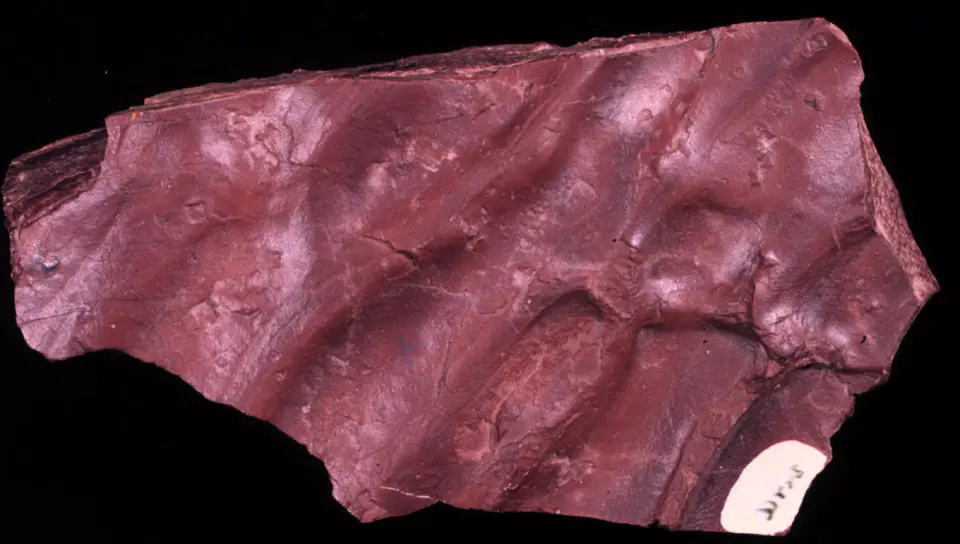
Mudstone contains variable clay minerals, very fine quartz and feldspar, organic matter, iron oxides, carbonate, and other detrital or chemical components. The term describes texture and splitting behavior, not a single composition.
What does mudstone look like?
Fresh mudstone is commonly dull and smooth, sometimes with subtle lamination, burrows, fossils, nodules, or shrinkage cracks. Weathering can create rounded chips or crumbly soil-like surfaces.
Dark color may reflect organic matter, sulfides, or other constituents, but color alone does not establish composition or petroleum potential.
Identification tests
Begin with observation and use the least destructive test first. Results can change with weathering, mixtures, coatings, and grain size. Review the step-by-step field-test methods before altering an unfamiliar specimen.
Grain size
Particles are mostly too small to identify unaidedSeparates mudstone from visibly sandy rock.
Fissility
Absent or weak; breaks blockily or irregularlyThe practical distinction from shale.
Acid response
Variable from none to noticeableFizz indicates carbonate content, not a separate grain-size name.
Useful procedures: Cleavage versus fracture · Acid reaction test
Common lookalikes
How does it form?
Mud accumulates in low-energy environments such as floodplains, lakes, deltas, tidal flats, and deeper marine settings.
Burial compacts the sediment and reduces pore space. Cementation and clay-mineral changes turn soft mud into coherent rock.
Geologic setting and occurrence
Mudstone is among the most abundant sedimentary rocks and occurs in basins throughout the United States, commonly interbedded with sandstone, siltstone, limestone, evaporites, or coal.
Informal usage of mudstone, shale, claystone, and argillite varies. Record observable grain size and splitting behavior when terminology is uncertain.
Uses and significance
Mudstone and clay-rich rocks may supply brick, cement, lightweight aggregate, or ceramic materials where composition is suitable. Many varieties weather poorly as construction stone.
Field notes
- Do not infer oil, gas, or coal potential from dark color alone.
- Some units contain pyrite, swelling clay, or naturally occurring hazardous elements; avoid dust.
- Road cuts and undercut mudstone slopes can fail suddenly after wet weather.
This guide supports preliminary field identification, not a laboratory determination, appraisal, hazard assessment, or statement of ownership or collecting permission. Verify land status and local rules before handling or collecting material.
Authoritative sources
LithoMap wrote this guide in original language using the scientific concepts and physical-property standards supported by these sources.
- Sedimentary Rocks U.S. National Park Service
- How Rocks Are Classified U.S. National Park Service
- Rocks and Minerals U.S. National Park Service
- What is the difference between a rock and a mineral? U.S. Geological Survey
Editorial review: September 17, 2026.