
.jpg)
What is shale?
Shale contains clay minerals and silt-size particles, commonly mixed with quartz, feldspar, organic matter, carbonate, or iron minerals. “Mudstone” is used when similar fine rock lacks pronounced fissility.
What does shale look like?
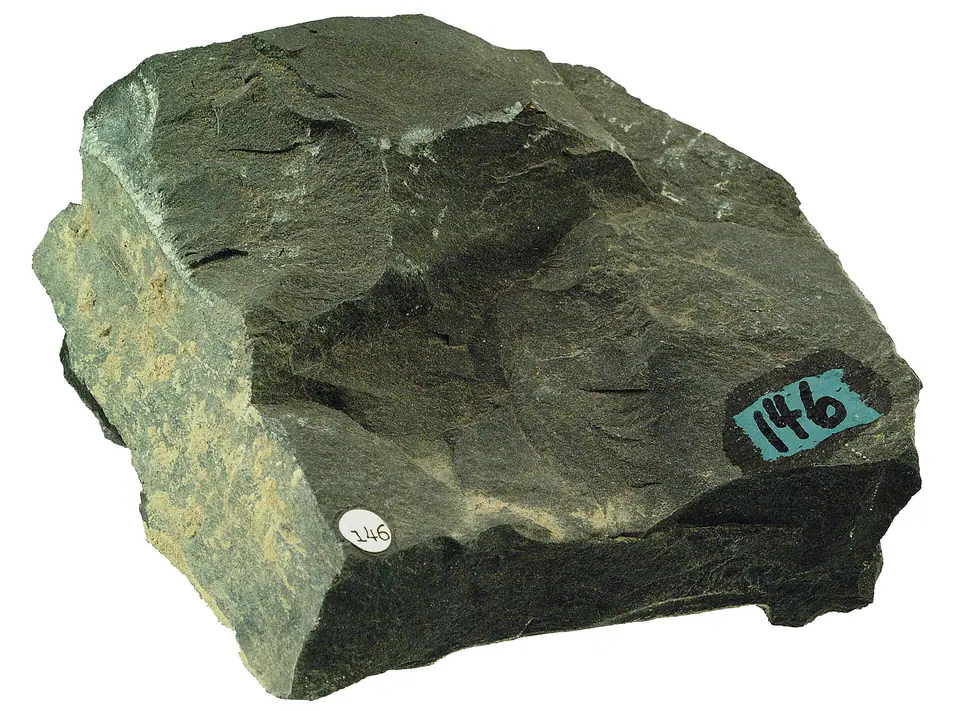
Fresh shale breaks into thin sheets or chips parallel to bedding. Surfaces may be dull, smooth, or slightly gritty depending on silt content.
Organic-rich shale can be dark and may stain fingers; iron oxidation produces red, yellow, or brown weathering. Some shale expands or crumbles rapidly when wet.
Identification tests
Begin with observation and use the least destructive test first. Results can change with weathering, mixtures, coatings, and grain size. Review the step-by-step field-test methods before altering an unfamiliar specimen.
Grain size
Clay- and silt-size particlesIndividual grains are generally invisible or barely perceptible.
Splitting
Thin, bedding-parallel flakesFissility favors shale over massive mudstone.
Hardness
Generally scratched by a knife and may crumble when weatheredSlate is typically harder and rings more clearly when tapped.
Useful procedures: Cleavage versus fracture · Mohs hardness test
Common lookalikes
How does it form?
Shale develops from mud deposited in relatively quiet water or low-energy environments, including offshore marine settings, lakes, floodplains, and lagoons.
Compaction aligns platy clay minerals and squeezes water from sediment. Burial and cementation convert mud to rock; stronger alteration can eventually produce slate.
Geologic setting and occurrence
Shale is widespread in layered sedimentary sequences and commonly forms slopes between more resistant sandstone or limestone beds.
Dark shale can host fossils, organic matter, sulfides, or natural resources, but those features are not universal and may vary bed by bed.
Uses and significance
Shale is used in bricks, cement, ceramics, lightweight aggregate, and as a source rock or seal in some petroleum systems. Engineering behavior depends strongly on mineralogy and moisture.
Field notes
- Weathered shale slopes can fail or become slick when wet.
- Dark color alone does not prove high organic content or economic resources.
- Fine dust may irritate lungs; avoid unnecessary crushing.
This guide supports preliminary field identification, not a laboratory determination, appraisal, hazard assessment, or statement of ownership or collecting permission. Verify land status and local rules before handling or collecting material.
Authoritative sources
LithoMap wrote this guide in original language using the scientific concepts and physical-property standards supported by these sources.
- How Rocks Are Classified U.S. National Park Service
- Rocks and Minerals U.S. National Park Service
- What is the difference between a rock and a mineral? U.S. Geological Survey
Editorial review: September 17, 2026.