
.jpg)
.jpg)
The most useful distinction
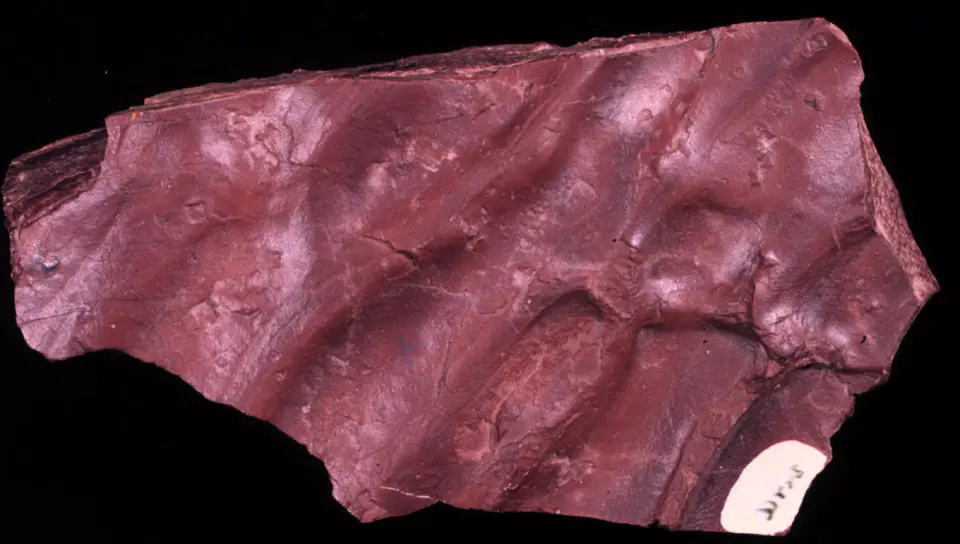
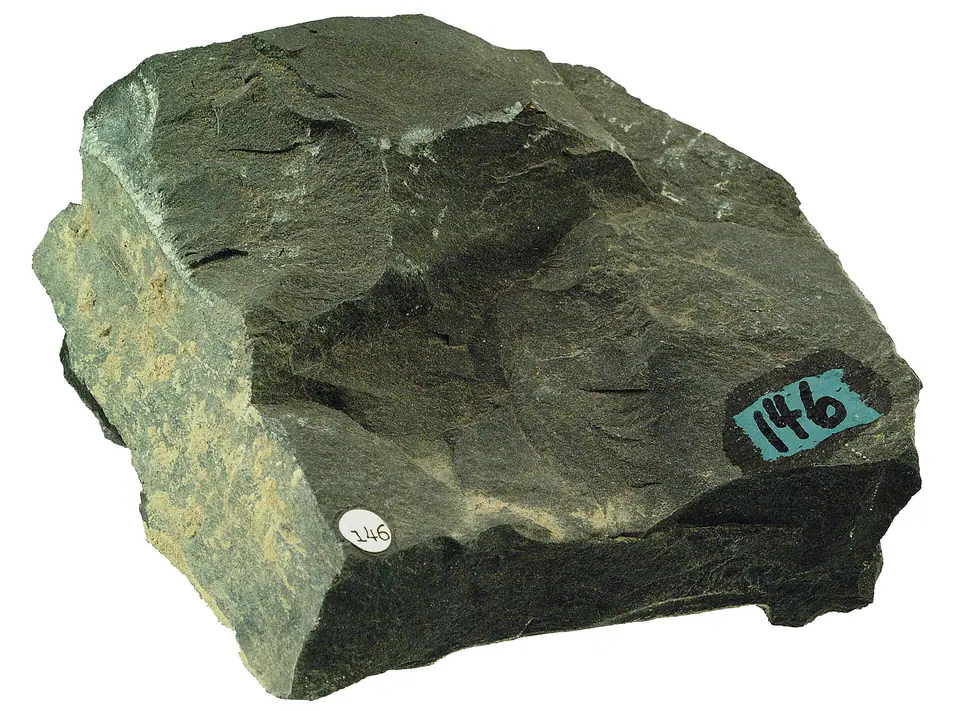
Watch how fresh rock breaks. Repeated thin bedding-parallel sheets favor shale; massive, blocky, or irregular fragments favor mudstone.
Mudstone and Shale comparison table
| Property | Mudstone | Shale | How to use it |
|---|---|---|---|
| Fissility | Absent or weak | Well developed, producing thin sheets or flakes | The principal practical distinction. |
| Grain size | Clay- and silt-size particles | Clay- and silt-size particles | Grain size overlaps, so it does not separate the pair alone. |
| Breakage | Blocky, chunky, or irregular | Platy and bedding-parallel | Use fresh material because weathering can make either rock flaky. |
| Terminology | Broad nonfissile fine-clastic term | Fine-clastic rock with fissile fabric | Published map units may use historical or regional naming conventions. |
A practical identification sequence
- 1
Find a fresh surface connected to the outcrop.
- 2
Identify bedding independently from joints and weathering cracks.
- 3
Observe whether the rock repeatedly splits along closely spaced bedding planes.
- 4
Record “mudrock” when weathering or sample size prevents a confident distinction.
Where the distinction gets difficult
- Surface weathering can make mudstone appear fissile.
- Metamorphic slate cleavage may mimic shale splitting but can cut across bedding.
- Dark color does not prove organic richness, oil, gas, or coal potential.
Use several independent observations. This comparison supports preliminary field identification, not laboratory confirmation, appraisal, proof of origin, or collecting permission.
Mudstone vs. shale FAQ
Is all shale mudstone?
Both belong to the mudrock family, but many schemes reserve mudstone for nonfissile rock and shale for fissile rock.
Can mudstone become shale?
Compaction and fabric development can create fissility, but terminology also varies among geologists and map units.
Why does weathered mudstone flake?
Wet–dry cycles, clay swelling, bedding, and surface stress can create flakes that do not represent primary shale fissility.
Authoritative sources
LithoMap wrote this comparison in original language from the physical properties and geological concepts supported by these public scientific references.
- Sedimentary Rocks U.S. National Park Service
- How Rocks Are Classified U.S. National Park Service
- Rocks and Minerals U.S. National Park Service
- What is the difference between a rock and a mineral? U.S. Geological Survey
Editorial review: September 17, 2026.