
.jpg)
.jpg)
The most useful distinction
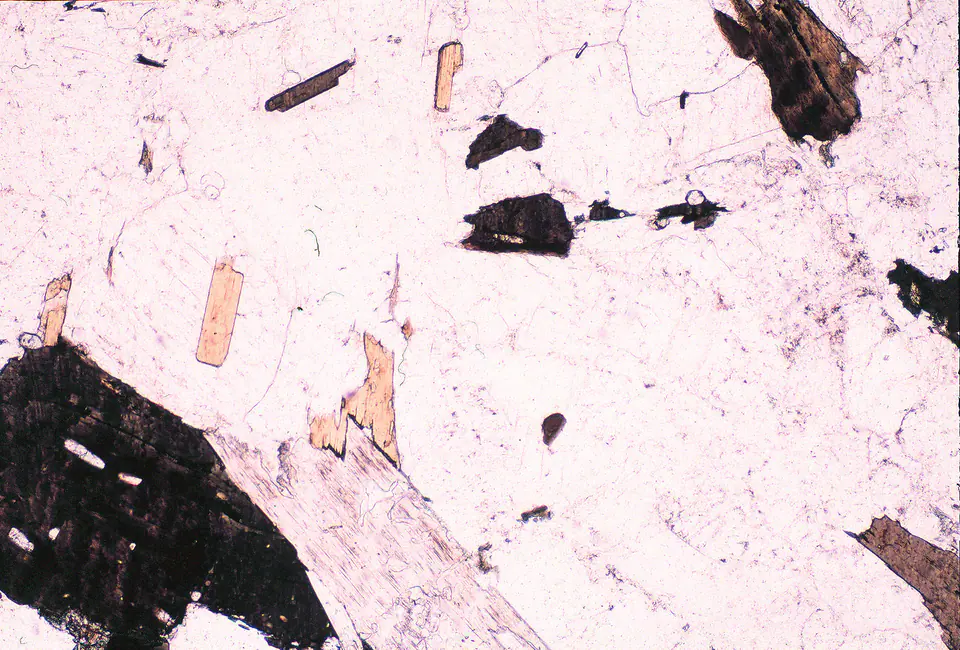
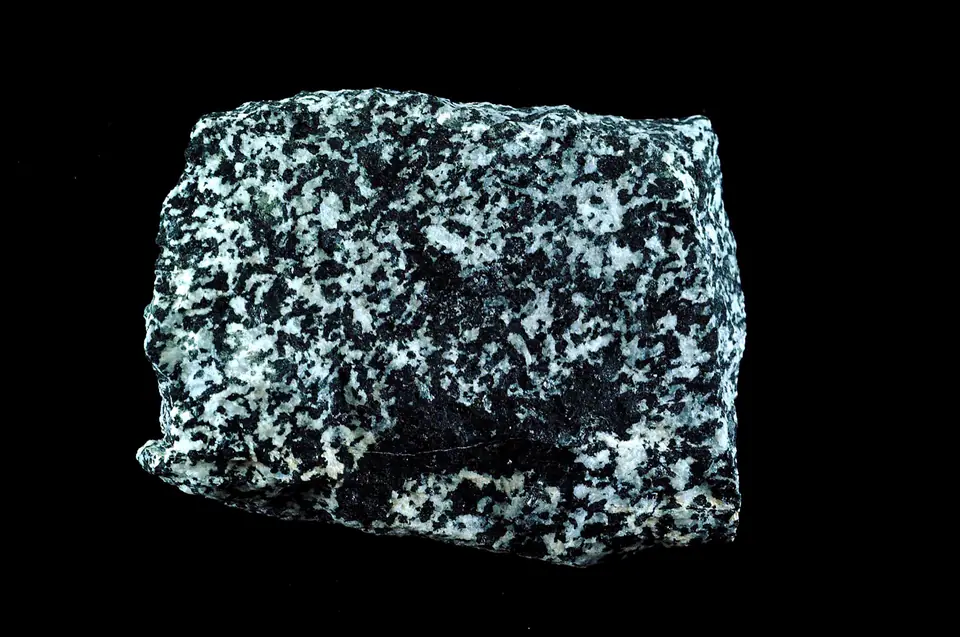
Estimate mineral proportions on a fresh surface. Abundant obvious quartz and alkali feldspar favor granite; dominant plagioclase with roughly balanced dark amphibole or pyroxene favors diorite.
Granite and Diorite comparison table
| Property | Granite | Diorite | How to use it |
|---|---|---|---|
| Overall appearance | Usually light gray, white, or pink with scattered dark grains | Commonly an even black-and-white salt-and-pepper pattern | Color balance is a useful first clue, but alteration and grain proportions cause overlap. |
| Quartz | A major visible component in true granite | Absent or subordinate in typical diorite | Multiple glassy, irregular quartz grains strongly favor granite. |
| Feldspar | Alkali feldspar is important and may be pink, with plagioclase also present | Plagioclase dominates the pale fraction | Feldspar identity matters more than pale color alone. |
| Dark minerals | Usually a smaller proportion of mica or amphibole | Commonly more abundant amphibole, pyroxene, or biotite | The higher dark-mineral proportion gives many diorites their balanced contrast. |
A practical identification sequence
- 1
Find a fresh surface with several dozen visible grains.
- 2
Identify glassy irregular quartz separately from blocky feldspar.
- 3
Estimate the proportion and distribution of dark minerals.
- 4
Use granodiorite or quartz diorite as possibilities when the features overlap.
Where the distinction gets difficult
- Igneous rock names depend on mineral proportions that can be difficult to estimate by eye.
- Weathering may make feldspar chalky and hide quartz.
- Commercial “granite” includes many stones that are not geological granite.
Use several independent observations. This comparison supports preliminary field identification, not laboratory confirmation, appraisal, proof of origin, or collecting permission.
Granite vs. diorite FAQ
Is diorite just dark granite?
No. Diorite has a different typical mineral balance and intermediate composition, although both are coarse intrusive rocks.
Can diorite contain quartz?
Yes, in limited amounts. Increasing quartz changes the formal name toward quartz diorite or granodiorite depending on feldspar proportions.
Is the salt-and-pepper pattern diagnostic?
It is characteristic but not conclusive. Some granites, gabbros, and metamorphic rocks can look similar, so check quartz, feldspar, and fabric.
Authoritative sources
LithoMap wrote this comparison in original language from the physical properties and geological concepts supported by these public scientific references.
- Igneous Rocks U.S. National Park Service
- How Rocks Are Classified U.S. National Park Service
- Rocks and Minerals U.S. National Park Service
- What is the difference between a rock and a mineral? U.S. Geological Survey
Editorial review: September 17, 2026.