
.jpg)
What is diorite?
Diorite is compositionally intermediate between felsic granite and mafic gabbro. Plagioclase is typically the main light mineral, accompanied by hornblende, pyroxene, or biotite; quartz and alkali feldspar may be present in smaller amounts. Exact classification can require modal mineral counts.
What does diorite look like?
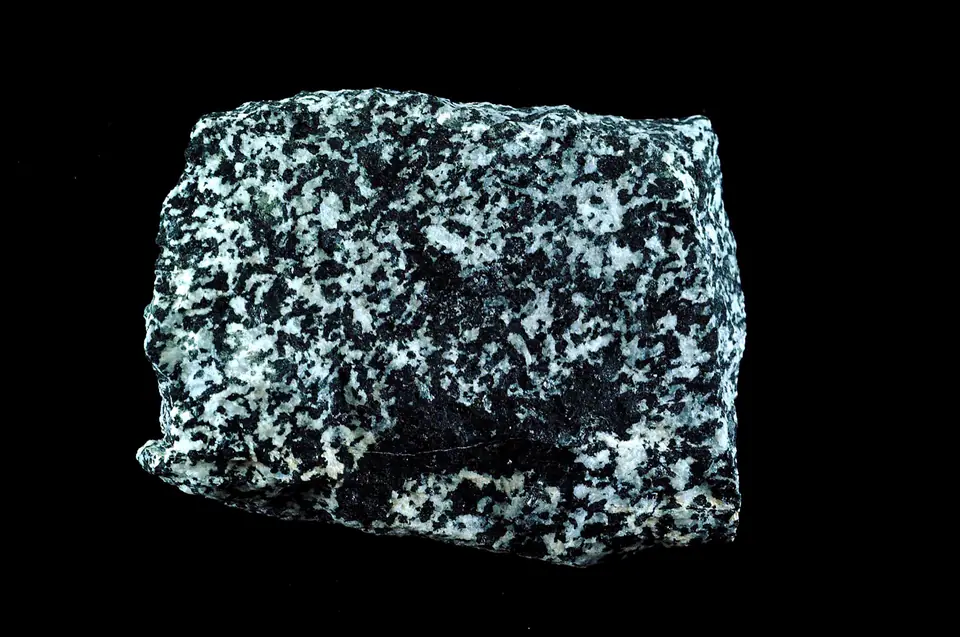
Fresh diorite commonly has millimeter-scale white or gray plagioclase intergrown with dark prismatic or flaky minerals. The proportions can vary enough that some samples look lighter or darker than the familiar salt-and-pepper pattern.
Weathering may turn feldspar chalky and dark minerals rusty or greenish. Veins, enclaves, or local crystal concentration can make one hand sample unrepresentative of the larger intrusion.
Identification tests
Begin with observation and use the least destructive test first. Results can change with weathering, mixtures, coatings, and grain size. Review the step-by-step field-test methods before altering an unfamiliar specimen.
Texture
Coarse, fully crystalline, interlocking grainsSeparates diorite from fine-grained andesite of broadly similar composition.
Quartz abundance
Usually absent or subordinate to feldsparAbundant obvious quartz and alkali feldspar favor granite or granodiorite.
Hardness
Feldspar-rich surfaces generally scratch glassA soft, earthy, or cemented granular rock is unlikely to be fresh diorite.
Useful procedures: Mohs hardness test
Common lookalikes
How does it form?
Diorite crystallizes slowly from intermediate magma below the surface, allowing visible mineral grains to grow.
It occurs in plutons, stocks, dikes, and composite intrusive complexes, especially where magmas evolve or mix above subduction zones.
Geologic setting and occurrence
Dioritic rocks occur in continental volcanic arcs, mountain belts, and composite plutonic complexes across the western United States and other convergent-margin regions.
A hand sample may fall near the boundaries among diorite, quartz diorite, granodiorite, and gabbro. A precise name may require thin-section work and mineral proportions.
Uses and significance
Diorite is used locally as crushed aggregate, curbing, monuments, and dimension stone where fracture spacing and durability are suitable.
Field notes
- Judge several fresh surfaces rather than color alone.
- Do not infer a specific pluton from a loose cobble.
- Avoid unstable quarry faces and obtain permission before collecting.
This guide supports preliminary field identification, not a laboratory determination, appraisal, hazard assessment, or statement of ownership or collecting permission. Verify land status and local rules before handling or collecting material.
Authoritative sources
LithoMap wrote this guide in original language using the scientific concepts and physical-property standards supported by these sources.
- Igneous Rocks U.S. National Park Service
- How Rocks Are Classified U.S. National Park Service
- Rocks and Minerals U.S. National Park Service
- What is the difference between a rock and a mineral? U.S. Geological Survey
Editorial review: September 17, 2026.