
.jpg)
What is gneiss?
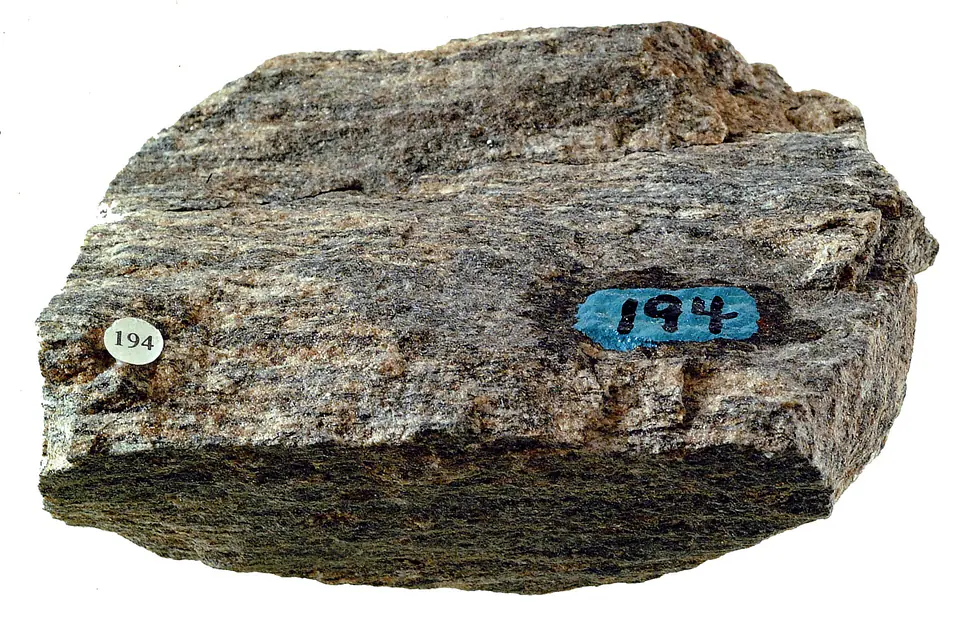
Gneiss commonly contains feldspar and quartz in light bands with biotite, amphibole, pyroxene, or other dark minerals in darker bands. Composition reflects both the parent rock and metamorphic reactions.
What does gneiss look like?
Bands may be straight, folded, discontinuous, or streaked. Individual crystals are usually visible, but the rock is defined by metamorphic fabric rather than grain size alone.
Some gneiss originated from granite-like igneous rock; other gneiss developed from sedimentary or volcanic precursors.
Identification tests
Begin with observation and use the least destructive test first. Results can change with weathering, mixtures, coatings, and grain size. Review the step-by-step field-test methods before altering an unfamiliar specimen.
Fabric
Coarse compositional bandingThe strongest field clue for gneiss.
Splitting
Generally blocky rather than thinly platyHelps separate gneiss from mica-rich schist.
Hardness
Quartz and feldspar bands scratch glassExpected for many gneisses but not sufficient by itself.
Useful procedures: Cleavage versus fracture · Mohs hardness test
Common lookalikes
Granite
Usually lacks persistent light-dark metamorphic banding and mineral alignment.
Schist
Typically has more abundant visible platy mica and splits along schistosity.
Layered igneous rock
May have compositional layers, but field relations and texture record magmatic rather than metamorphic segregation.
How does it form?
Gneiss forms under high temperatures and pressures that recrystallize minerals and segregate them into compositional layers during deformation.
Partial melting may generate pale granitic veins, producing mixed migmatitic textures that blur the boundary between metamorphic and igneous material.
Geologic setting and occurrence
Gneiss is common in deeply eroded mountain belts and ancient continental crust where rocks experienced high-grade metamorphism.
A banded sample alone cannot determine its parent rock, metamorphic age, or formal map unit. Those require regional relationships and often geochemical work.
Uses and significance
Competent gneiss is used locally as dimension stone, landscaping stone, and crushed aggregate. Strong foliation can influence how blocks split or weather.
Field notes
- Describe band thickness, continuity, folding, and mineral alignment.
- Do not infer “metamorphosed granite” unless evidence supports that protolith.
- Watch for loose blocks beneath steep banded outcrops.
This guide supports preliminary field identification, not a laboratory determination, appraisal, hazard assessment, or statement of ownership or collecting permission. Verify land status and local rules before handling or collecting material.
Authoritative sources
LithoMap wrote this guide in original language using the scientific concepts and physical-property standards supported by these sources.
- How Rocks Are Classified U.S. National Park Service
- Rocks and Minerals U.S. National Park Service
- What is the difference between a rock and a mineral? U.S. Geological Survey
Editorial review: September 17, 2026.