
.jpg)
What is granite?
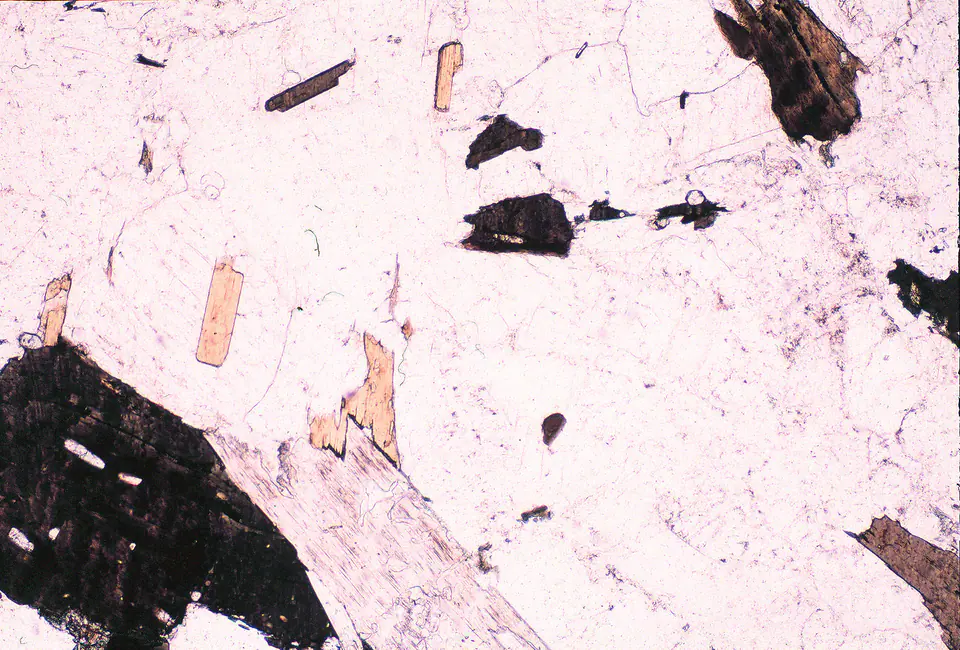
True granite is silica-rich and dominated by quartz plus alkali feldspar, with plagioclase and smaller amounts of mica, amphibole, or other accessory minerals. “Granite” is also used commercially for several coarse crystalline stones that geologists would name differently.
What does granite look like?
Fresh granite has a speckled, crystalline surface. Individual grains meet along irregular boundaries rather than appearing as rounded sand grains held by cement.
Grain size varies from a few millimeters to exceptionally large crystals. Weathering can turn feldspar chalky and loosen the rock into gritty decomposed granite.
Identification tests
Begin with observation and use the least destructive test first. Results can change with weathering, mixtures, coatings, and grain size. Review the step-by-step field-test methods before altering an unfamiliar specimen.
Texture
Coarse, interlocking crystalsSeparates granite from sandstone, whose grains are discrete and commonly rounded.
Hardness
Quartz grains scratch glass; feldspar is also relatively hardA uniformly soft or easily scratched rock is unlikely to be fresh granite.
Acid
No general fizz with dilute acidStrong reaction suggests carbonate-rich rock or carbonate filling a fracture.
Useful procedures: Mohs hardness test · Acid reaction test
Common lookalikes
Diorite
Typically has less quartz and a more evenly balanced black-and-white “salt and pepper” appearance.
Gneiss
Commonly shows mineral banding or alignment produced by metamorphism; granite is generally massive and unlayered.
Arkose sandstone
Contains separate sand grains and cement rather than fully interlocking crystals.
How does it form?
Granite crystallizes from silica-rich magma below Earth’s surface. Slow cooling gives mineral crystals time to grow large enough to see.
Later uplift and erosion expose the formerly buried intrusion. Fractures may create blocky outcrops, domes, and rounded boulders as weathering removes corners and edges.
Geologic setting and occurrence
Granite is widespread in continental mountain belts, ancient crystalline cores, and exposed batholiths. It may occur as large intrusive bodies, smaller stocks, dikes, or glacially transported boulders far from bedrock sources.
A hand sample can identify a granite-like rock, but naming an intrusion or mapping its exact extent requires local geologic context and often laboratory petrography.
Uses and significance
Granite and related dimension stones are used for buildings, monuments, countertops, curbing, and crushed aggregate. Commercial stone names do not always match geological classification.
Field notes
- Check a fresh broken surface; weathered rind can hide crystals and colors.
- Do not infer a named pluton from appearance alone.
- Never hammer road cuts, structures, monuments, archaeological sites, or protected outcrops.
This guide supports preliminary field identification, not a laboratory determination, appraisal, hazard assessment, or statement of ownership or collecting permission. Verify land status and local rules before handling or collecting material.
Authoritative sources
LithoMap wrote this guide in original language using the scientific concepts and physical-property standards supported by these sources.
- Igneous Rocks U.S. National Park Service
- How Rocks Are Classified U.S. National Park Service
- Rocks and Minerals U.S. National Park Service
- What is the difference between a rock and a mineral? U.S. Geological Survey
Editorial review: September 17, 2026.