
.jpg)
.jpg)
The most useful distinction
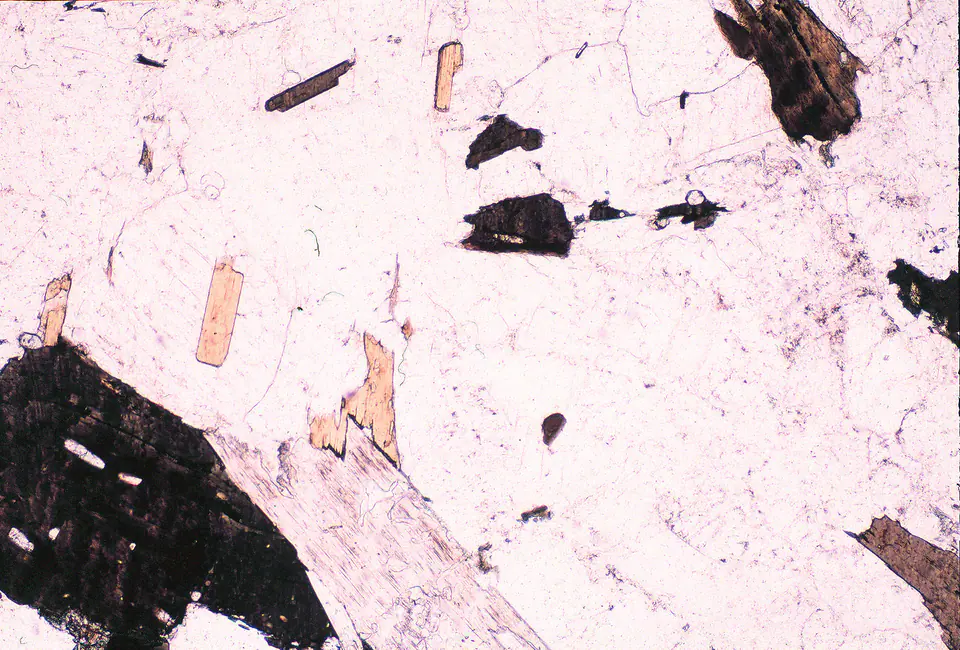
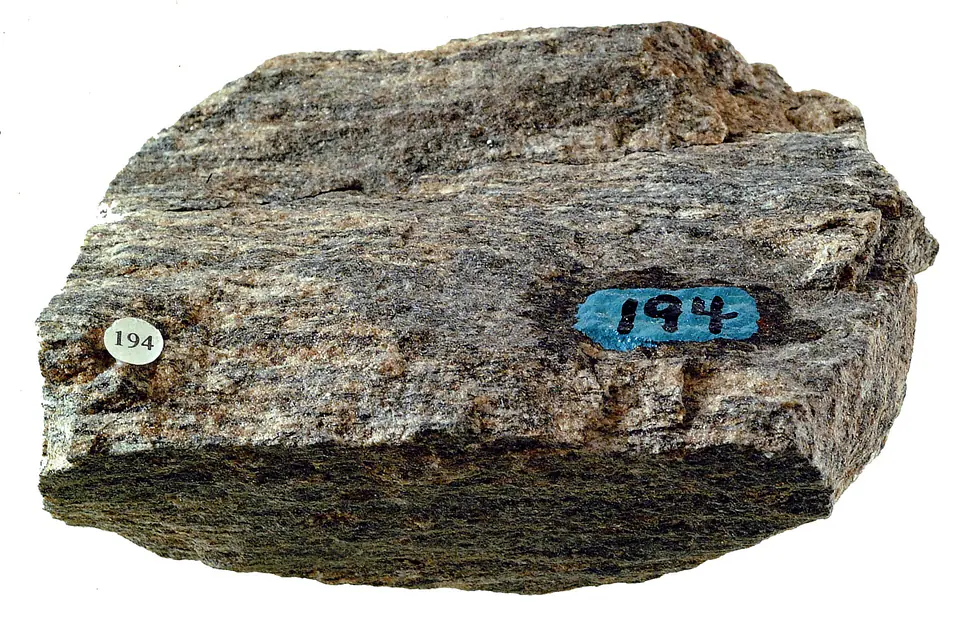
Look for organization, not just mineral identity. A speckled mosaic with no persistent direction favors granite; repeated light-and-dark bands or aligned minerals favor gneiss.
Granite and Gneiss comparison table
| Property | Granite | Gneiss | How to use it |
|---|---|---|---|
| Texture | Coarse interlocking crystals with no required alignment | Coarse crystals commonly organized into a planar fabric | A persistent fabric is the strongest hand-sample distinction. |
| Banding | Generally absent, although veins and magmatic layering can occur | Commonly shows alternating light and dark mineral-rich domains | Follow a suspected band across the sample or outcrop; random patches are weaker evidence. |
| Origin | Slow crystallization of magma below the surface | Recrystallization and segregation during high-grade metamorphism | Nearby contacts and mapped context may confirm the process recorded by the texture. |
| Fracture and weathering | Often blocky and massive; feldspar may weather to a gritty surface | May split or weather preferentially along the metamorphic fabric | Breakage is supporting evidence, not a substitute for observing fresh texture. |
A practical identification sequence
- 1
Examine a fresh surface and identify quartz, feldspar, and dark minerals.
- 2
Rotate the sample and ask whether mineral alignment persists in one direction.
- 3
Trace any light-and-dark domains across the whole sample rather than judging one patch.
- 4
Compare the hand sample with the outcrop fabric and a local geologic map.
Where the distinction gets difficult
- Strongly deformed granite may grade into granitic gneiss, so the boundary is not always sharp.
- A vein cutting granite is not the same as repeated gneissic banding.
- Commercial stone labels do not reliably follow geological classification.
Use several independent observations. This comparison supports preliminary field identification, not laboratory confirmation, appraisal, proof of origin, or collecting permission.
Granite vs. gneiss FAQ
Can granite turn into gneiss?
Yes. Sufficient heat, pressure, deformation, and recrystallization can transform granitic rock into granitic gneiss.
Do granite and gneiss have the same minerals?
They can share quartz, feldspar, mica, and amphibole. Their texture and mineral arrangement are usually more diagnostic than the mineral list alone.
Is every banded rock gneiss?
No. Sedimentary bedding, volcanic flow bands, veins, and alteration can also produce layers. Confirm an interlocking metamorphic fabric.
Authoritative sources
LithoMap wrote this comparison in original language from the physical properties and geological concepts supported by these public scientific references.
- Igneous Rocks U.S. National Park Service
- How Rocks Are Classified U.S. National Park Service
- Rocks and Minerals U.S. National Park Service
- What is the difference between a rock and a mineral? U.S. Geological Survey
Editorial review: September 17, 2026.