
.jpg)
.jpg)
The most useful distinction
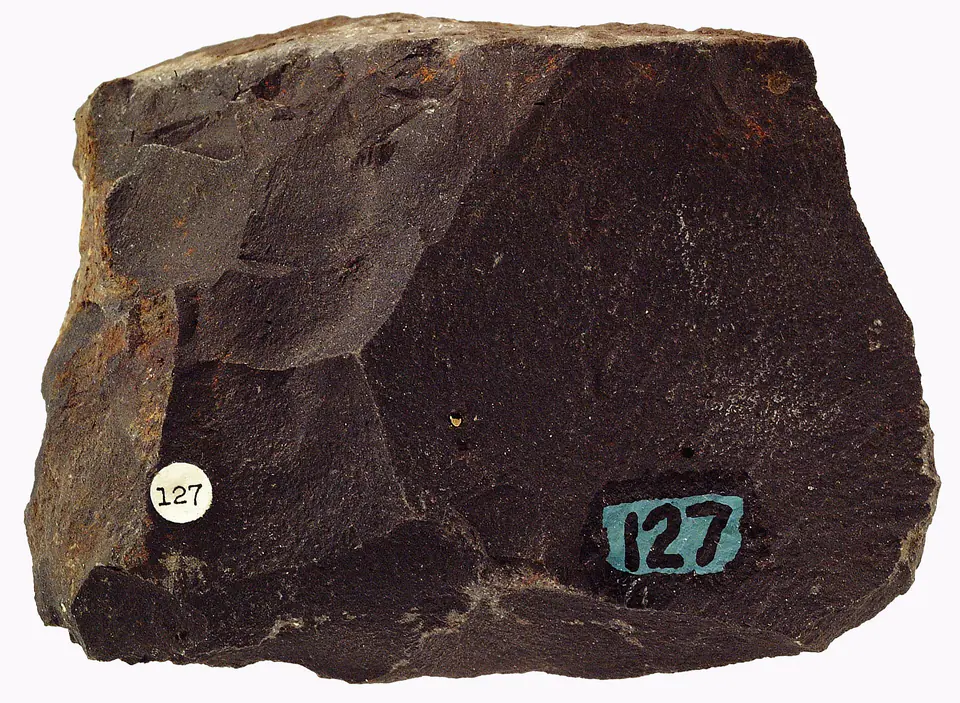
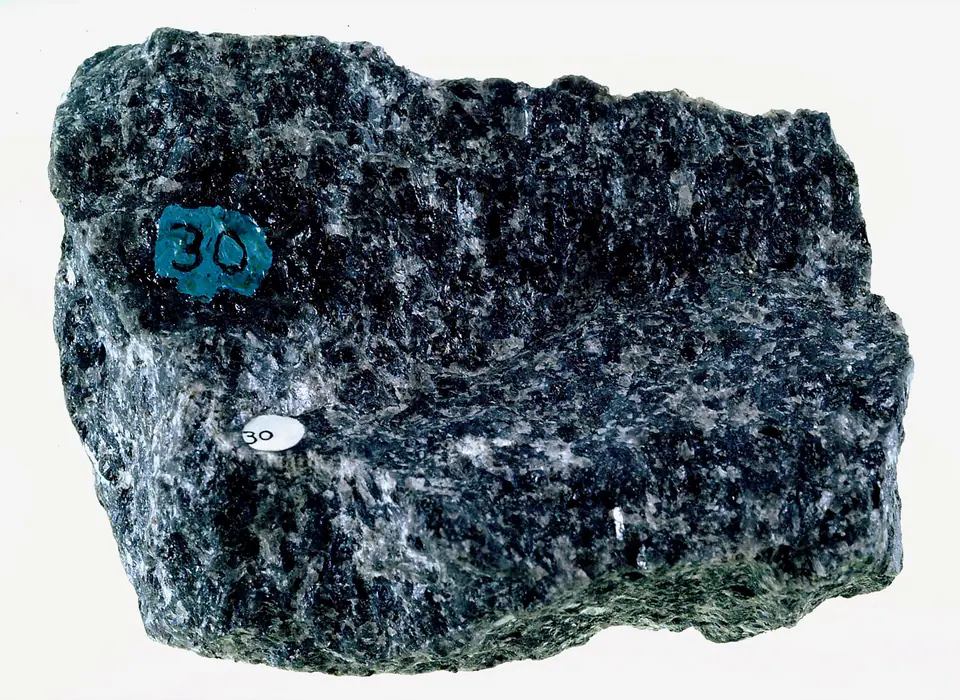
Use grain size first. A dark rock with a nearly uniform microscopic groundmass favors basalt; visible interlocking plagioclase and pyroxene throughout favor gabbro.
Basalt and Gabbro comparison table
| Property | Basalt | Gabbro | How to use it |
|---|---|---|---|
| Grain size | Fine grained; most crystals are too small to identify unaided | Coarse grained; principal minerals are visible | Cooling rate recorded by grain size is the clearest distinction. |
| Cooling setting | Lava or shallow volcanic material | Slowly cooled intrusive magma | Outcrop relationships can confirm what the texture implies. |
| Vesicles | Common in some flows and cinders | Generally absent | Gas-bubble cavities support basalt but dense basalt may have none. |
| Minerals | Microscopic plagioclase and pyroxene, commonly with olivine | Visible plagioclase and pyroxene, commonly with olivine | The similar mineral system explains why these rocks are compositional counterparts. |
A practical identification sequence
- 1
Inspect a fresh dry surface with a hand lens.
- 2
Ask whether crystals are visible throughout or only as sparse phenocrysts.
- 3
Look for vesicles, glassy margins, or flow structures.
- 4
Use outcrop contacts or a geologic map to test volcanic versus intrusive context.
Where the distinction gets difficult
- Diabase or dolerite has an intermediate grain size and may bridge the field appearance.
- Altered gabbro can resemble metamorphic greenstone or amphibolite.
- A porphyritic basalt may contain large crystals but still has a fine-grained groundmass.
Use several independent observations. This comparison supports preliminary field identification, not laboratory confirmation, appraisal, proof of origin, or collecting permission.
Basalt vs. gabbro FAQ
Do basalt and gabbro have the same composition?
They broadly occupy the same mafic compositional family, though individual samples and formal classifications vary.
Can gabbro have holes like basalt?
Typical gabbro lacks vesicles because it crystallizes under pressure underground. Cavities may instead be weathering pits or later fractures.
Which rock is darker?
Both are usually dark. Color is less reliable than whether the texture is fine grained or visibly crystalline.
Authoritative sources
LithoMap wrote this comparison in original language from the physical properties and geological concepts supported by these public scientific references.
- Igneous Rocks U.S. National Park Service
- How Rocks Are Classified U.S. National Park Service
- Rocks and Minerals U.S. National Park Service
- What is the difference between a rock and a mineral? U.S. Geological Survey
Editorial review: September 17, 2026.