
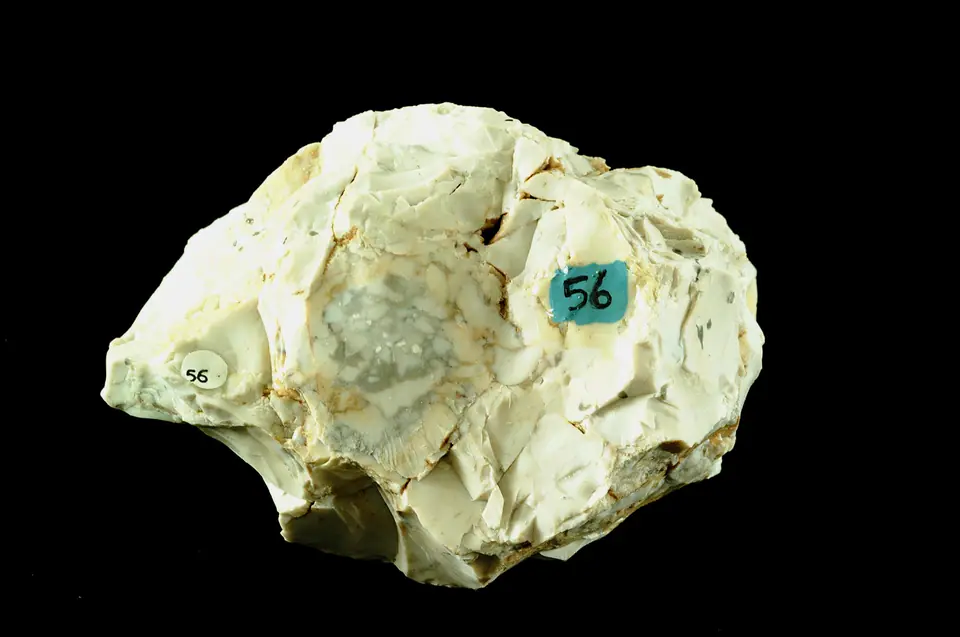
.jpg)
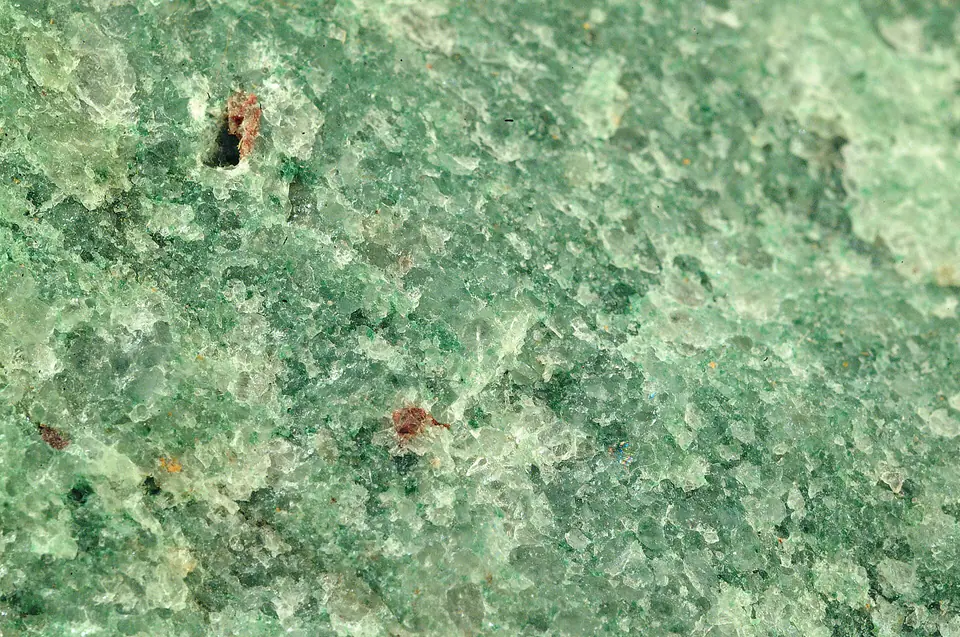
.jpg)
The most useful distinction
Hardness will not separate them, so inspect texture. Smooth, grainless conchoidal fracture favors chert; visible fused grains and fracture cutting through a granular mosaic favor quartzite.
Chert and Quartzite comparison table
| Property | Chert | Quartzite | How to use it |
|---|---|---|---|
| Grain visibility | Microcrystalline; individual grains are not visible unaided | Commonly shows a sugary or fused granular quartz mosaic | Texture is the most useful hand-sample distinction. |
| Fracture | Strongly conchoidal, smooth, and extremely sharp | Irregular to splintery and cuts through fused grains; may be locally conchoidal | Fracture geometry supports the texture observation. |
| Typical occurrence | Nodules or beds in sedimentary sequences and silica-rich deposits | Metamorphosed sandstone beds, ridges, and mountain belts | Outcrop form and host rock can resolve ambiguous pieces. |
| Surface luster | Waxy to glassy on a fresh break | Granular, glassy, or sugary as quartz grains reflect separately | Luster is useful only on clean unweathered surfaces. |
A practical identification sequence
- 1
Confirm that a fresh edge scratches ordinary glass.
- 2
Use a hand lens to search for a fused granular mosaic.
- 3
Compare smooth curved fracture with fracture through grains.
- 4
Check whether the material forms nodules in sedimentary rock or continuous metamorphosed beds.
Where the distinction gets difficult
- Both rocks produce razor-sharp splinters when broken.
- Very fine quartzite and recrystallized chert may require thin-section study.
- Do not disturb chert artifacts, flakes, or archaeological sites.
Use several independent observations. This comparison supports preliminary field identification, not laboratory confirmation, appraisal, proof of origin, or collecting permission.
Chert vs. quartzite FAQ
Which is harder, chert or quartzite?
Both are dominated by quartz and typically scratch glass, so ordinary hardness tests rarely separate them.
Is flint different from chert?
Flint is a traditional name commonly applied to certain cherts, especially dark nodules in chalk or limestone; usage varies.
Can quartzite fracture conchoidally?
It can locally, especially when very fine and silica-rich. Look for a granular mosaic and field context rather than one fracture surface.
Authoritative sources
LithoMap wrote this comparison in original language from the physical properties and geological concepts supported by these public scientific references.
- How Rocks Are Classified U.S. National Park Service
- Rocks and Minerals U.S. National Park Service
- What is the difference between a rock and a mineral? U.S. Geological Survey
Editorial review: September 17, 2026.