
.jpg)
.jpg)
The most useful distinction
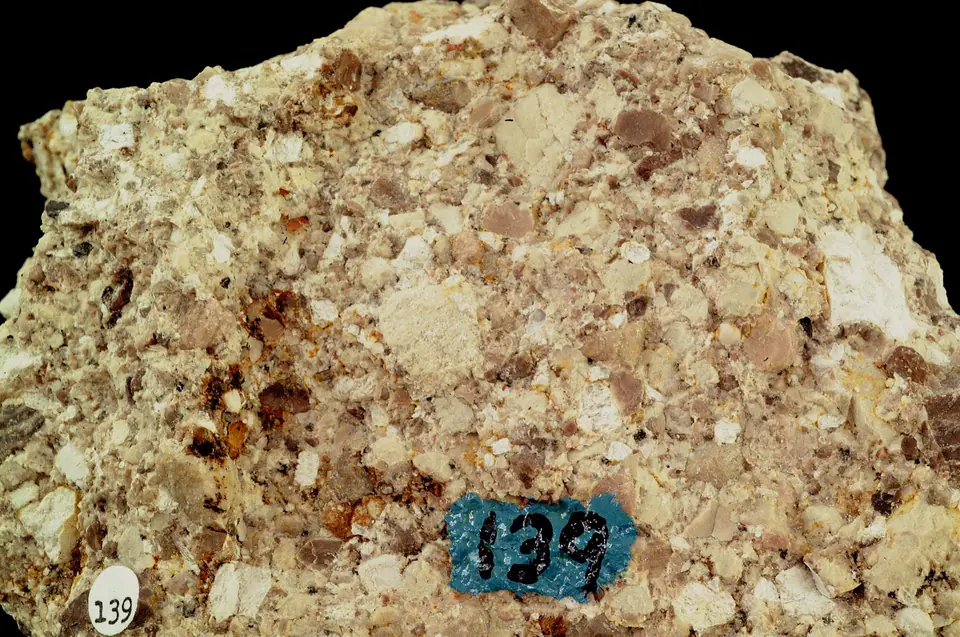
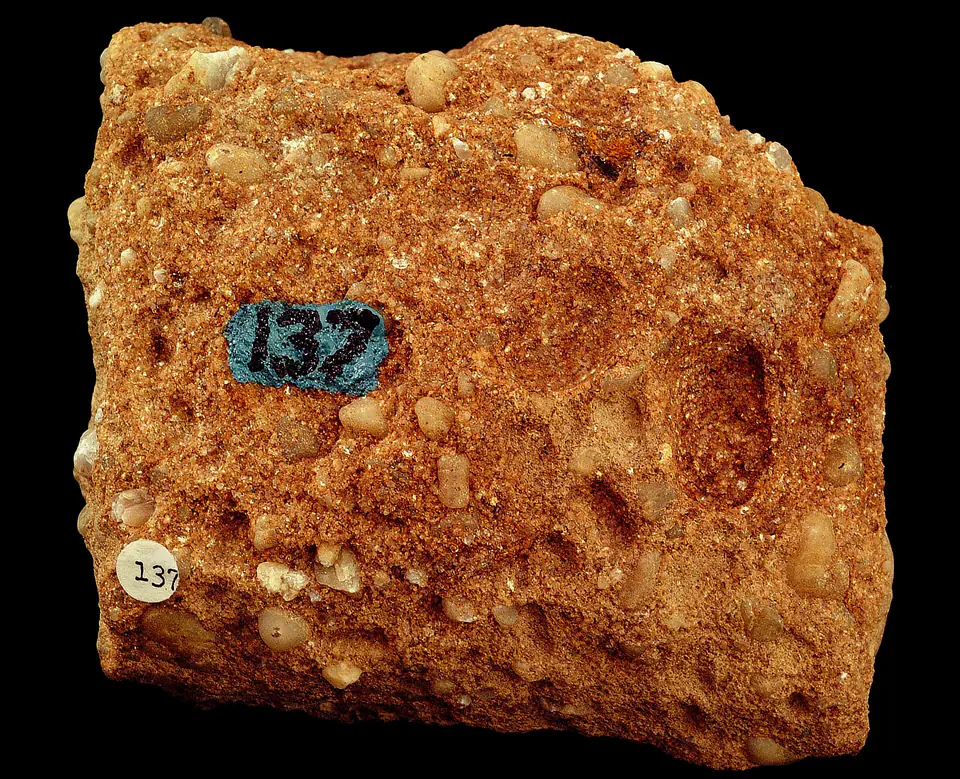
Look across many large fragments. Sharp corners and broken outlines favor breccia; smoothly rounded pebbles and cobbles favor conglomerate. A mixture should be described rather than forced into an absolute category.
Breccia and Conglomerate comparison table
| Property | Breccia | Conglomerate | How to use it |
|---|---|---|---|
| Clast shape | Predominantly angular to subangular | Predominantly rounded to subrounded | This is the defining hand-sample distinction. |
| Transport implication | Often limited abrasion or in-place fragmentation | Usually substantial abrasion during water, ice, wave, or sediment transport | Shape suggests history but does not uniquely identify the setting. |
| Possible origins | Sedimentary, fault, volcanic, collapse, hydrothermal, or impact processes | Sedimentary deposition in channels, beaches, fans, or related environments | Breccia is especially broad and requires outcrop context. |
| Matrix and sorting | Highly variable | Highly variable | Matrix abundance and sorting describe the rock but do not replace clast shape. |
A practical identification sequence
- 1
Identify only particles larger than two millimeters as gravel-size clasts.
- 2
Estimate angularity across many clasts, not one broken pebble.
- 3
Record sorting, matrix proportion, clast composition, and support.
- 4
Use bedding, faults, volcanic structures, or contacts to interpret origin.
Where the distinction gets difficult
- Breaking a conglomerate can expose angular interiors even though the original clasts are rounded.
- A sediment can contain both angular and rounded clasts.
- Angular fragments do not by themselves demonstrate a fault, eruption, or meteorite impact.
Use several independent observations. This comparison supports preliminary field identification, not laboratory confirmation, appraisal, proof of origin, or collecting permission.
Breccia vs. conglomerate FAQ
Can breccia and conglomerate occur together?
Yes. Deposits can grade laterally or vertically as transport distance and energy change, and mixed clast shapes are common.
Is every breccia volcanic?
No. Volcanic breccia is only one type; faults, slopes, caves, hydrothermal systems, collapse, and impacts can also generate breccia.
What if only one clast is angular?
Classify the overall population. One recently broken or locally derived fragment should not determine the name.
Authoritative sources
LithoMap wrote this comparison in original language from the physical properties and geological concepts supported by these public scientific references.
- How Rocks Are Classified U.S. National Park Service
- Rocks and Minerals U.S. National Park Service
- What is the difference between a rock and a mineral? U.S. Geological Survey
Editorial review: September 17, 2026.