
.jpg)
What is conglomerate?
Composition depends on the source terrain. Quartz, chert, limestone, volcanic, metamorphic, or igneous clasts may be mixed with sand, silt, clay, or mineral cement.
What does conglomerate look like?
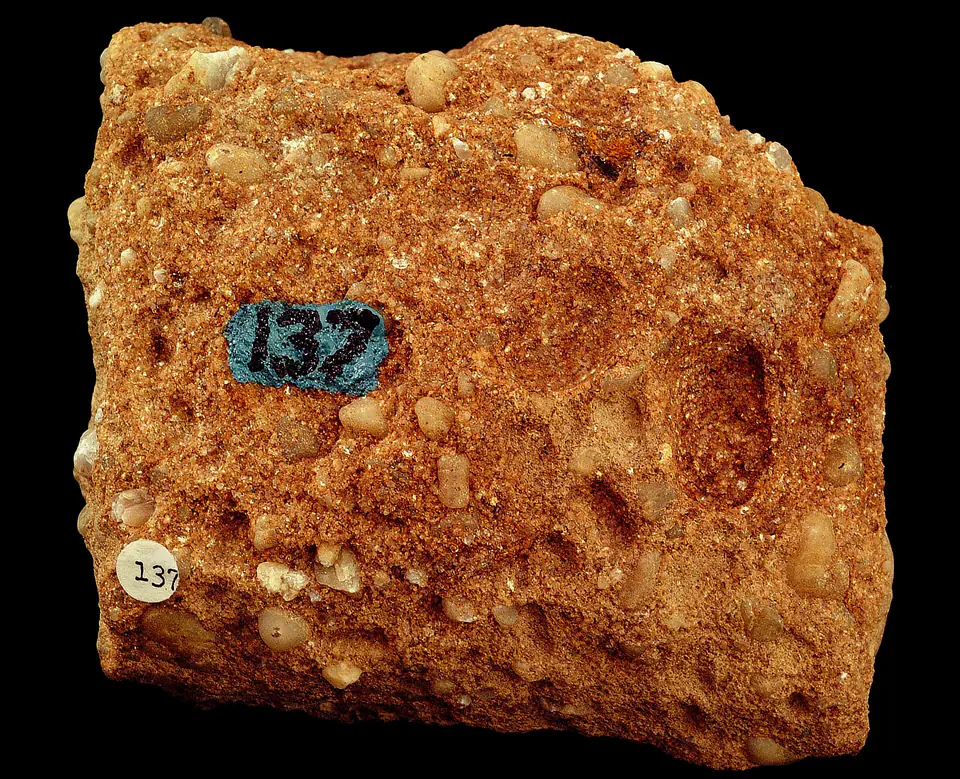
Conglomerate resembles a naturally cemented gravel. Roundness reflects abrasion during transport, although clast shape also depends on the original rock and travel history.
Matrix-supported varieties have abundant fine material between clasts; clast-supported varieties have pebbles touching one another. Both can occur in the same deposit.
Identification tests
Begin with observation and use the least destructive test first. Results can change with weathering, mixtures, coatings, and grain size. Review the step-by-step field-test methods before altering an unfamiliar specimen.
Clast size
A substantial fraction exceeds 2 millimetersSeparates conglomerate from sandstone.
Roundness
Clasts are predominantly rounded to subroundedSeparates conglomerate from angular-clast breccia.
Cement
Silica, carbonate, iron oxide, or clay may bind the depositVariable cement explains different hardness and acid response.
Common lookalikes
Breccia
Contains dominantly angular gravel-size fragments, indicating less abrasion or a different process.
Concrete
Manufactured aggregate may show uniform cement paste, reinforcing material, or human context.
Glacial till
Unlithified till is not cemented rock and commonly contains poorly sorted angular and rounded material together.
How does it form?
Conglomerate forms in high-energy settings such as river channels, alluvial fans, beaches, glacial outwash, and some debris-flow deposits.
Burial and cementation convert gravel to rock. Clast size, sorting, imbrication, and composition help reconstruct flow direction and source areas.
Geologic setting and occurrence
Conglomerate occurs near ancient basin margins, river systems, shorelines, and uplifted terrain. Resistant beds may form ledges or cliffs.
The clasts may be older than the conglomerate by millions or billions of years, so dating a pebble does not directly date deposition.
Uses and significance
Some conglomerate is used as decorative building stone or aggregate. Geologists study its clasts and sedimentary structures to reconstruct paleogeography and erosion history.
Field notes
- Look at many clasts before judging roundness or composition.
- Cliff-forming beds can release large blocks and cobbles.
- Do not mistake concrete rubble for bedrock conglomerate.
This guide supports preliminary field identification, not a laboratory determination, appraisal, hazard assessment, or statement of ownership or collecting permission. Verify land status and local rules before handling or collecting material.
Authoritative sources
LithoMap wrote this guide in original language using the scientific concepts and physical-property standards supported by these sources.
- How Rocks Are Classified U.S. National Park Service
- Rocks and Minerals U.S. National Park Service
- What is the difference between a rock and a mineral? U.S. Geological Survey
Editorial review: September 17, 2026.