
.jpg)
What is breccia?
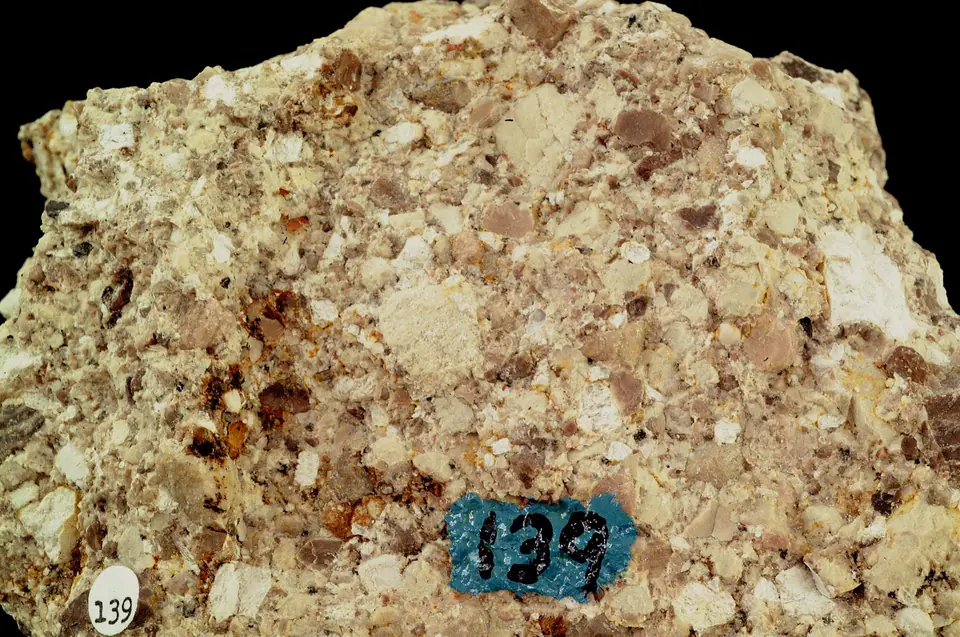
Breccia is defined primarily by fragment shape and size, not by one mineral composition. Clasts and matrix can be sedimentary, igneous, metamorphic, hydrothermal, or mixed.
What does breccia look like?
Fragments larger than two millimeters have sharp corners or irregular broken outlines. Some are clast-supported; others appear to float in abundant fine matrix.
Cement, veins, alteration, pressure solution, or weathering may blur original edges. Tectonic crushing can produce polished or striated surfaces, while volcanic breccia may include vesicular or glassy fragments.
Identification tests
Begin with observation and use the least destructive test first. Results can change with weathering, mixtures, coatings, and grain size. Review the step-by-step field-test methods before altering an unfamiliar specimen.
Clast shape
Most gravel-size fragments are angular to subangularSeparates typical breccia from conglomerate with predominantly rounded clasts.
Clast boundaries
Discrete fragments sit in matrix or cementSeparates breccia from a coarse interlocking crystalline rock.
Context
Outcrop structures, contacts, and associated rocks vary by originRequired before labeling the sample sedimentary, fault, volcanic, collapse, or impact breccia.
Common lookalikes
Conglomerate
Contains predominantly rounded gravel-size clasts produced by greater abrasion during transport.
Porphyritic igneous rock
Large crystals grew within magma and have crystal shapes rather than broken rock-fragment outlines.
Cataclasite
A fault rock commonly dominated by finer crushed material and tectonic fabric; terms overlap in some field classifications.
How does it form?
Sedimentary breccia can accumulate near steep slopes, caves, debris flows, or alluvial fans where transport is short. Fault breccia forms by brittle crushing, and volcanic breccia forms through explosive fragmentation or broken lava.
Collapse, hydrothermal activity, and meteorite impacts can also create breccia. The hand-sample texture alone rarely proves which process occurred.
Geologic setting and occurrence
Breccias occur at fault zones, volcanic centers, talus aprons, caves, collapse structures, hydrothermal systems, and impact sites throughout the United States.
Claims of an impact origin require regional structures, shock features, geochemistry, or other independent evidence; angular fragments alone are not evidence of a meteorite impact.
Uses and significance
Some cemented breccias are used as decorative stone or aggregate. Mineralized hydrothermal breccias may be explored, but brecciation alone does not indicate valuable mineralization.
Field notes
- Record clast size, angularity, sorting, matrix, and contact relationships.
- Fault breccia may mark unstable fractured ground.
- Do not assign a dramatic origin without evidence beyond the hand specimen.
This guide supports preliminary field identification, not a laboratory determination, appraisal, hazard assessment, or statement of ownership or collecting permission. Verify land status and local rules before handling or collecting material.
Authoritative sources
LithoMap wrote this guide in original language using the scientific concepts and physical-property standards supported by these sources.
- How Rocks Are Classified U.S. National Park Service
- Rocks and Minerals U.S. National Park Service
- What is the difference between a rock and a mineral? U.S. Geological Survey
Editorial review: September 17, 2026.