
.jpg)
What is andesite?
Andesite has an intermediate silica content and commonly contains plagioclase with pyroxene, amphibole, or biotite. Field appearance overlaps basalt, dacite, and altered volcanic rock; chemical analysis is often needed near compositional boundaries.
What does andesite look like?
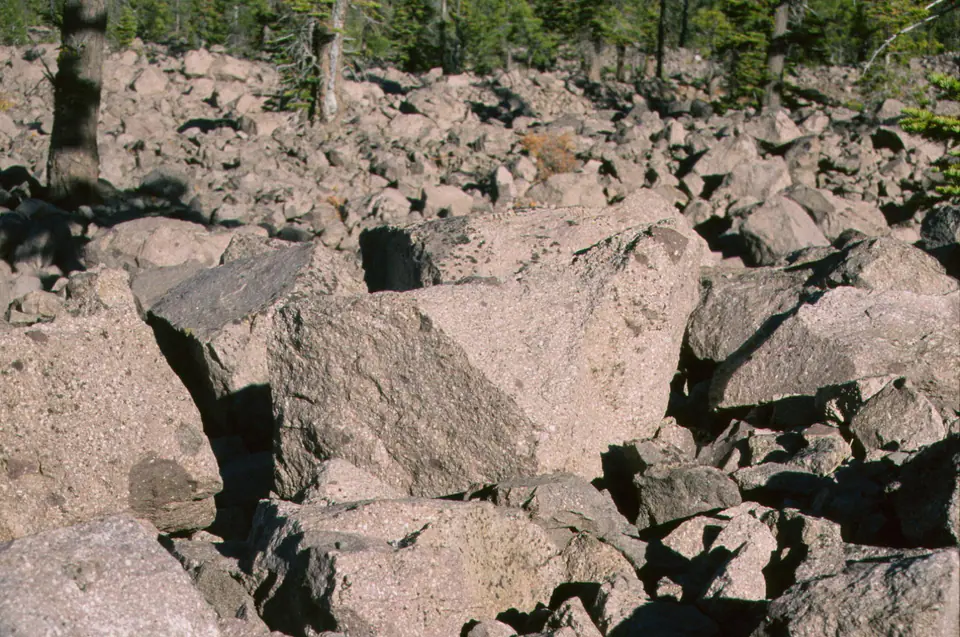
Many andesites are porphyritic, with blocky white feldspar crystals suspended in a uniform gray matrix. Others are nearly aphyric and resemble basalt.
Flow banding, vesicles, oxidation, hydrothermal alteration, and volcanic fragments may complicate the surface. Weathered andesite can be brown, reddish, greenish, or pale gray.
Identification tests
Begin with observation and use the least destructive test first. Results can change with weathering, mixtures, coatings, and grain size. Review the step-by-step field-test methods before altering an unfamiliar specimen.
Grain size
Groundmass crystals are microscopicSeparates andesite from coarse-grained diorite.
Phenocrysts
Plagioclase with possible amphibole or pyroxeneSupports an intermediate volcanic rock but does not by itself exclude basalt or dacite.
Magnetism
Variable, commonly weakMay support iron-bearing volcanic rock but cannot determine composition.
Useful procedures: Mineral magnetism test
Common lookalikes
Basalt
Commonly darker and more mafic; borderline samples require chemical or microscopic evidence.
Dacite or rhyolite
Usually lighter and more silica-rich, sometimes with visible quartz.
Diorite
Has a coarse intrusive texture with visible crystals throughout rather than a fine groundmass.
How does it form?
Andesite forms when intermediate magma erupts and cools quickly in lava flows, domes, dikes near the surface, or volcanic fragments.
It is especially common in continental and island volcanic arcs above subduction zones, though intermediate magmas develop in other tectonic settings as well.
Geologic setting and occurrence
Andesite is widespread in volcanic arcs, including the Cascade Range, Aleutian chain, and many older western U.S. volcanic fields.
Formal volcanic-unit names incorporate mapped relationships, age, and chemistry. A gray porphyritic sample should not be assigned to a named unit on appearance alone.
Uses and significance
Competent andesite is quarried locally for aggregate, road stone, riprap, and dimension stone.
Field notes
- Compare a fresh interior because oxidation strongly changes color.
- Describe phenocryst type, size, and abundance rather than relying on “gray.”
- Volcanic cliffs, talus, fumaroles, and closed hazard zones require special caution.
This guide supports preliminary field identification, not a laboratory determination, appraisal, hazard assessment, or statement of ownership or collecting permission. Verify land status and local rules before handling or collecting material.
Authoritative sources
LithoMap wrote this guide in original language using the scientific concepts and physical-property standards supported by these sources.
- Igneous Rocks U.S. National Park Service
- How Rocks Are Classified U.S. National Park Service
- Rocks and Minerals U.S. National Park Service
- What is the difference between a rock and a mineral? U.S. Geological Survey
Editorial review: September 17, 2026.