
.jpg)
.jpg)
The most useful distinction
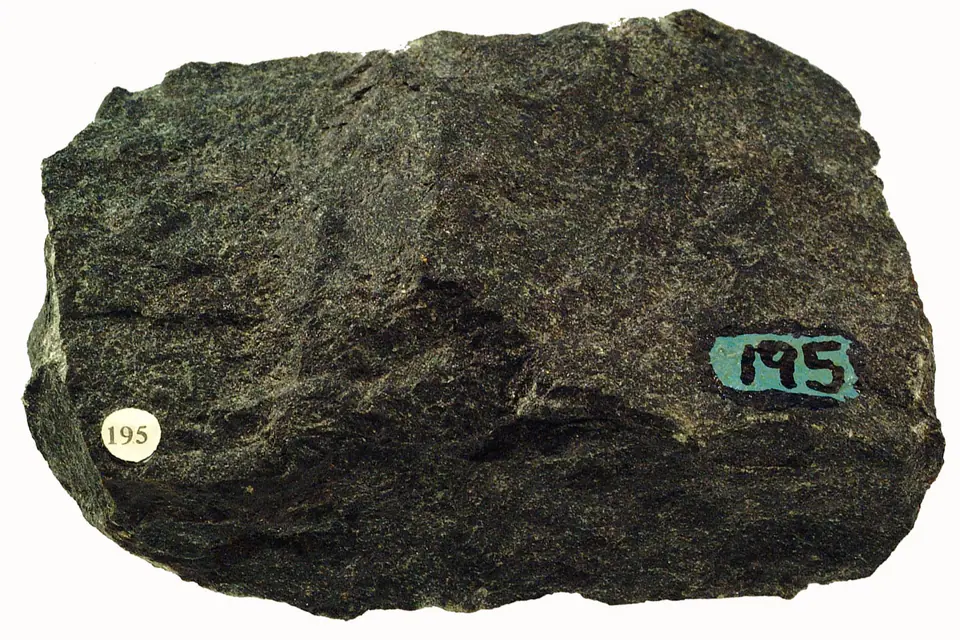
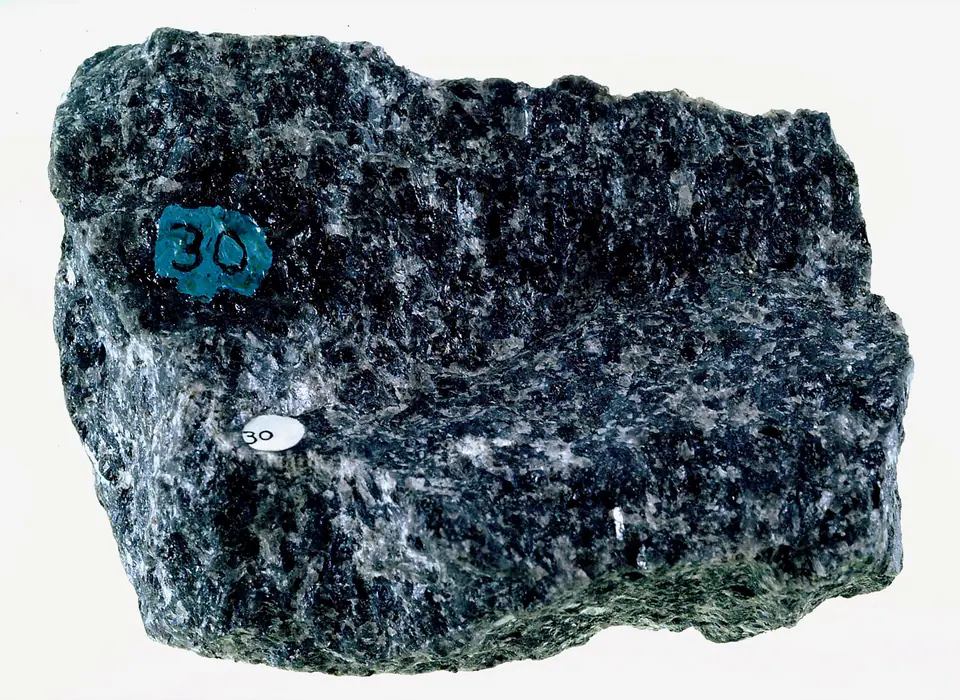
Look for fabric and mineral shape. Persistent alignment of shiny elongate amphibole favors amphibolite; randomly oriented blocky pyroxene and plagioclase favor gabbro.
Amphibolite and Gabbro comparison table
| Property | Amphibolite | Gabbro | How to use it |
|---|---|---|---|
| Origin | Metamorphic recrystallization, commonly of mafic rock | Slow crystallization of mafic magma underground | Texture records the contrasting process. |
| Fabric | May be foliated or lineated, though some is massive | Usually massive with random crystal orientation; igneous layering can occur | A pervasive metamorphic alignment is strong evidence. |
| Dominant dark mineral | Amphibole, commonly hornblende | Pyroxene, commonly with olivine or amphibole alteration | Crystal habit helps where grains are large enough. |
| Pale mineral | Plagioclase grains or patches | Interlocking plagioclase | Plagioclase occurs in both and cannot distinguish them alone. |
A practical identification sequence
- 1
Examine a fresh surface with a hand lens.
- 2
Look for a repeated direction in elongate dark grains.
- 3
Compare prismatic amphibole with blockier pyroxene cautiously.
- 4
Use contacts and regional mapping to test metamorphic versus intrusive context.
Where the distinction gets difficult
- Massive amphibolite and altered gabbro may require thin-section identification.
- Igneous layering is not automatically metamorphic foliation.
- Dark color and density alone cannot separate the rocks.
Use several independent observations. This comparison supports preliminary field identification, not laboratory confirmation, appraisal, proof of origin, or collecting permission.
Amphibolite vs. gabbro FAQ
Can gabbro become amphibolite?
Yes. Metamorphism can recrystallize gabbro into amphibolite, although basalt and other mafic rocks are also common precursors.
Is all amphibolite foliated?
No. Amphibolite ranges from strongly foliated to nearly massive.
Can gabbro contain hornblende?
Yes, as a primary or alteration mineral. Mineral abundance, fabric, and field context must be evaluated together.
Authoritative sources
LithoMap wrote this comparison in original language from the physical properties and geological concepts supported by these public scientific references.
- Metamorphic Rocks U.S. National Park Service
- How Rocks Are Classified U.S. National Park Service
- Rocks and Minerals U.S. National Park Service
- What is the difference between a rock and a mineral? U.S. Geological Survey
- Igneous Rocks U.S. National Park Service
Editorial review: September 17, 2026.