
.jpg)
.jpg)
The most useful distinction
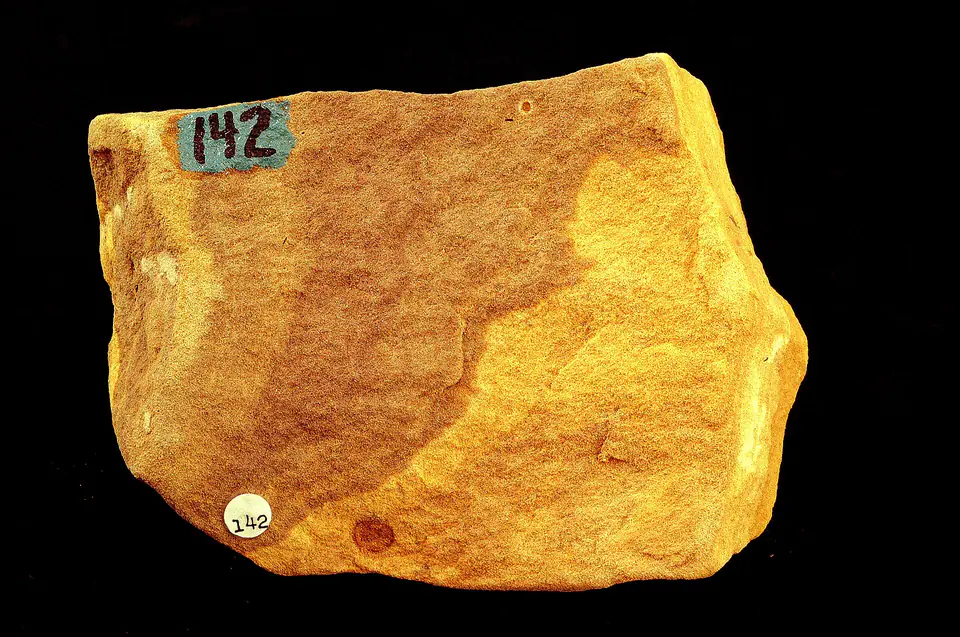
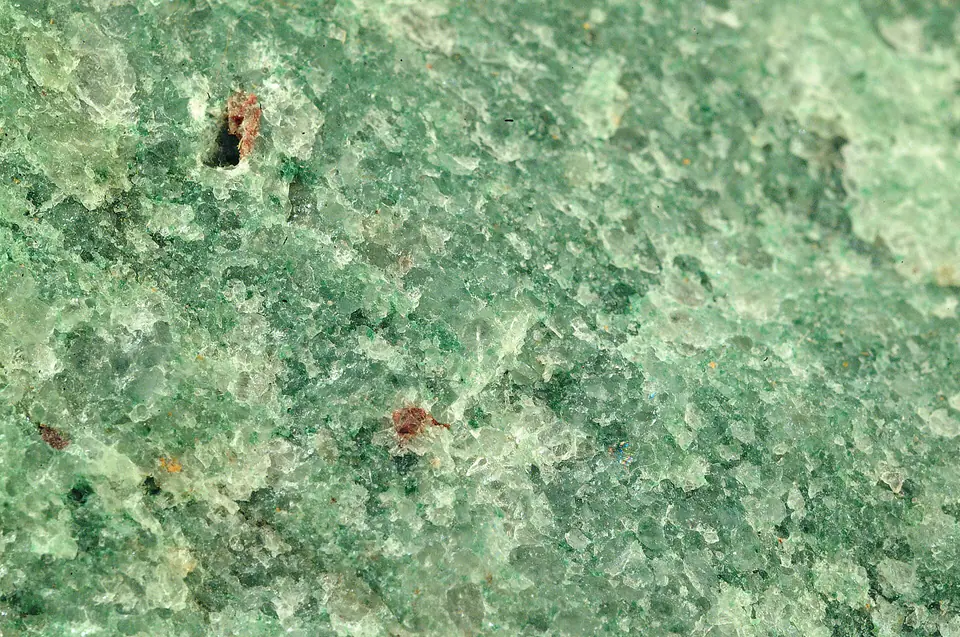
Watch how the rock breaks. Sandstone commonly breaks around separate grains or sheds them; well-recrystallized quartzite tends to break across grains through a tightly fused mass.
Sandstone and Quartzite comparison table
| Property | Sandstone | Quartzite | How to use it |
|---|---|---|---|
| Grain boundaries | Individual sand grains remain discrete and are joined by cement | Quartz grains are tightly interlocked; original boundaries may be difficult to trace | This is the central textural distinction. |
| Breakage | Fracture commonly follows cement and travels around grains | Fracture commonly cuts directly through the fused quartz mosaic | Examine a small existing fresh edge rather than damaging an outcrop. |
| Surface feel | Often gritty and may release grains when rubbed or scratched | Usually hard, dense, and glassy to sugary without loose grit | Weathering can soften either surface, so confirm on fresh material. |
| Structures | Bedding, cross-bedding, ripples, or pores may be clear | Original structures may survive but are commonly muted by recrystallization | Preserved structures do not rule out quartzite; evaluate the grain fabric too. |
A practical identification sequence
- 1
Find an existing fresh surface and use a hand lens to trace grain boundaries.
- 2
Check whether grains detach or whether the rock behaves as one fused mass.
- 3
Observe whether a fracture travels around or through quartz grains.
- 4
Use bedding and mapped metamorphic context as supporting evidence.
Where the distinction gets difficult
- “Quartzite” is used commercially for some hard sandstones and manufactured products.
- Silica-rich rocks can make sharp fragments and hazardous dust; avoid unnecessary breaking or grinding.
- Partly recrystallized meta-sandstone may sit between typical end members.
Use several independent observations. This comparison supports preliminary field identification, not laboratory confirmation, appraisal, proof of origin, or collecting permission.
Sandstone vs. quartzite FAQ
Is quartzite harder than sandstone?
Quartzite is usually more coherent because quartz grains are interlocked, but a silica-cemented sandstone can also be very hard. Texture remains essential.
Can sandstone scratch glass?
Its quartz grains can scratch glass even when the rock is sandstone, so that test alone does not prove quartzite.
Does quartzite still show bedding?
It can. Metamorphism may preserve, distort, or erase sedimentary structures depending on its intensity.
Authoritative sources
LithoMap wrote this comparison in original language from the physical properties and geological concepts supported by these public scientific references.
- How Rocks Are Classified U.S. National Park Service
- Rocks and Minerals U.S. National Park Service
- What is the difference between a rock and a mineral? U.S. Geological Survey
Editorial review: September 17, 2026.