
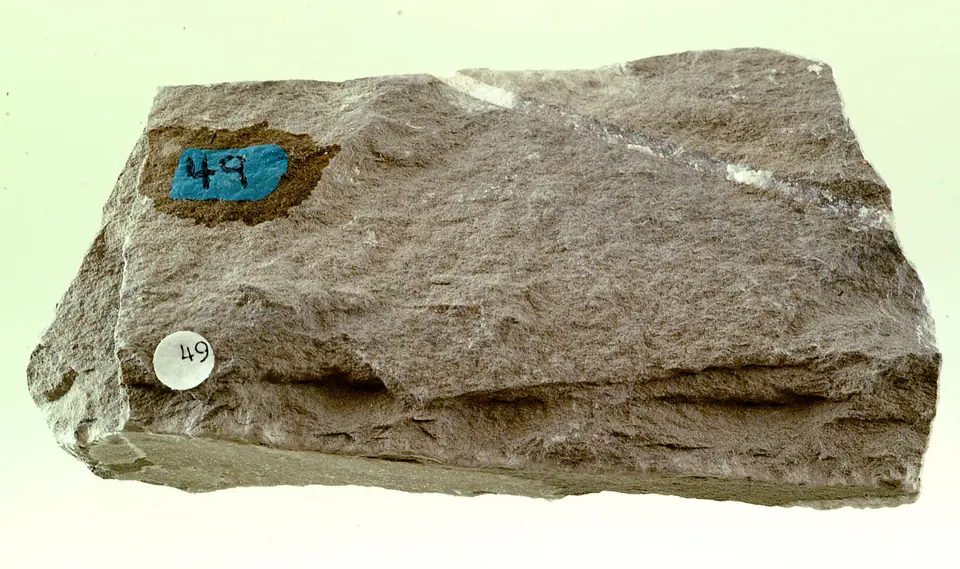
_(GeoDIL_number_-_238).jpg)
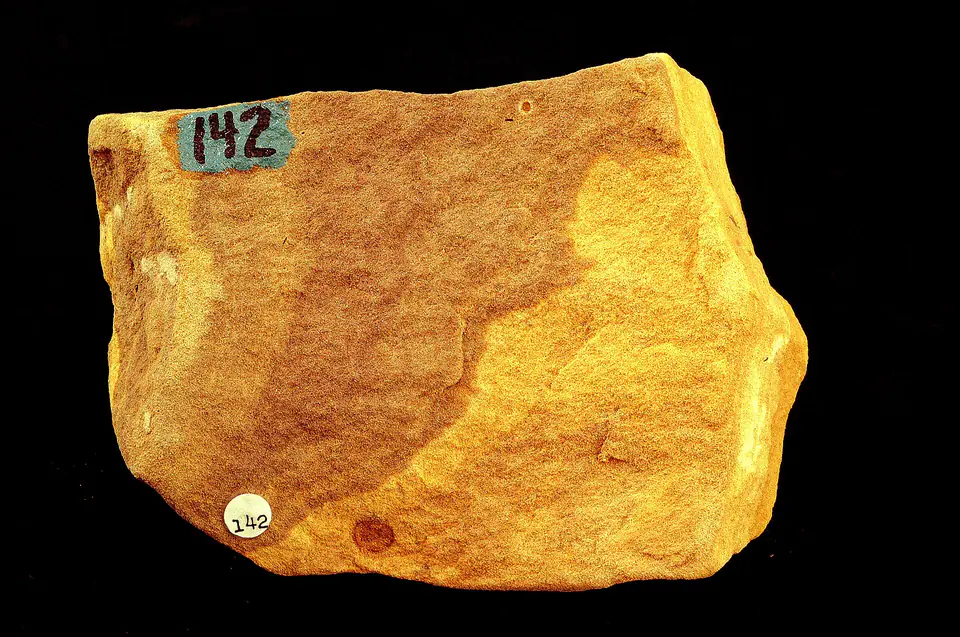
.jpg)
The most useful distinction
Use a fresh surface and hand lens. Barely perceptible grit without clearly visible grains favors siltstone; visible or distinctly felt sand grains favor sandstone.
Siltstone and Sandstone comparison table
| Property | Siltstone | Sandstone | How to use it |
|---|---|---|---|
| Dominant grain size | Silt, about 0.004 to 0.063 millimeters | Sand, about 0.063 to 2 millimeters | Particle size defines the distinction. |
| Unaided appearance | Generally smooth-looking with grains difficult to see | Commonly granular with at least some grains visible | Good lighting and a fresh break improve the observation. |
| Feel | Faintly gritty or floury | Distinctly gritty | Supporting evidence; avoid tasting or inhaling powder. |
| Typical breakage | Blocky, platy, or irregular depending on bedding and cement | Breaks around or through sand grains depending on cement | Breakage helps describe the sample but grain size remains primary. |
A practical identification sequence
- 1
Brush loose soil from a fresh dry surface.
- 2
Inspect with strong side light and a hand lens.
- 3
Compare grain visibility and gentle fingertip texture.
- 4
Describe borderline material as coarse siltstone or very fine sandstone rather than forcing certainty.
Where the distinction gets difficult
- Weathered surfaces can lose grains or become deceptively smooth.
- Silica cement can make fine sandstone unusually hard and quartzite-like.
- Do not lick rock to estimate grain size; dust may contain hazardous material.
Use several independent observations. This comparison supports preliminary field identification, not laboratory confirmation, appraisal, proof of origin, or collecting permission.
Siltstone vs. sandstone FAQ
Can siltstone scratch glass?
Quartz-rich siltstone may mark glass weakly, especially where cemented, so hardness does not define the name.
Is siltstone a type of shale?
Not necessarily. Siltstone is defined mainly by silt-sized grains, while shale is defined by fine grain size plus fissile splitting.
Why is the boundary hard to see?
Natural grain sizes form a continuum, and the formal sand–silt boundary is near the limit of unaided vision.
Authoritative sources
LithoMap wrote this comparison in original language from the physical properties and geological concepts supported by these public scientific references.
- Sedimentary Rocks U.S. National Park Service
- How Rocks Are Classified U.S. National Park Service
- Rocks and Minerals U.S. National Park Service
- What is the difference between a rock and a mineral? U.S. Geological Survey
Editorial review: September 17, 2026.