
_(GeoDIL_number_-_238).jpg)
What is siltstone?
Siltstone commonly contains quartz, feldspar, mica, clay minerals, and iron oxides. Its name describes dominant grain size rather than a fixed mineral recipe.
What does siltstone look like?
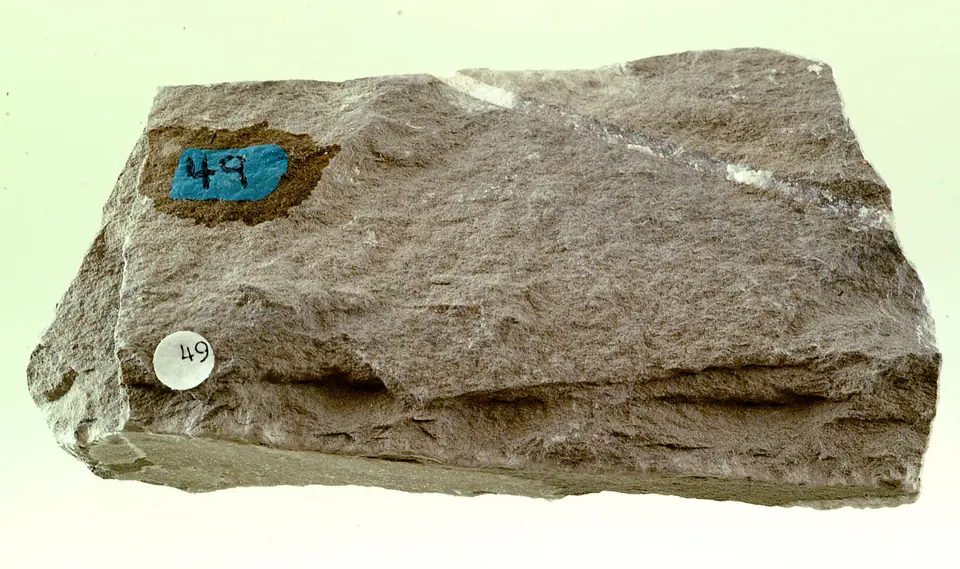
Fresh siltstone can look smooth at arm’s length, but strong side lighting or a hand lens may reveal tiny sparkles and grains. Thin lamination, ripple marks, burrows, or plant fragments may occur.
Weathering commonly produces platy chips or blocky fragments, but the rock does not consistently split along closely spaced bedding planes as fissile shale does.
Identification tests
Begin with observation and use the least destructive test first. Results can change with weathering, mixtures, coatings, and grain size. Review the step-by-step field-test methods before altering an unfamiliar specimen.
Grain feel
Faint grit without clearly visible sand grainsSupports siltstone between sandstone and mudstone.
Splitting
Commonly blocky or irregular rather than strongly fissileHelps separate siltstone from shale, though laminated siltstone may split.
Hardness
Variable with cement; quartz-rich grains may scratch glass only weakly as a rock surfaceCement and weathering make bulk hardness unreliable alone.
Useful procedures: Cleavage versus fracture · Mohs hardness test
Common lookalikes
Fine sandstone
Has coarser grains that are more readily visible or distinctly gritty.
Mudstone
Usually feels smoother and is dominated by clay- and mud-size particles.
Shale
Splits readily into thin layers along fissile bedding.
How does it form?
Silt settles where water, wind, or ice loses enough energy to deposit particles finer than sand but coarser than clay.
Compaction and cementation turn the sediment into rock in floodplains, deltas, lakes, shallow marine shelves, glacial settings, and windblown deposits.
Geologic setting and occurrence
Siltstone occurs in many sedimentary basins and commonly alternates with sandstone, shale, coal, or limestone in river, deltaic, lake, and marine successions.
Grain size varies continuously, so silty mudstone and very fine sandstone are legitimate boundary descriptions when a sample is intermediate.
Uses and significance
Competent siltstone may be used locally for fill, aggregate, flagstone, or construction stone, but durability varies greatly with cement, bedding, and weathering.
Field notes
- Use a hand lens and fresh surface; weathered coatings hide grain size.
- Avoid tasting or licking rock, and do not inhale powder.
- Thin-bedded outcrops can shed unstable slabs.
This guide supports preliminary field identification, not a laboratory determination, appraisal, hazard assessment, or statement of ownership or collecting permission. Verify land status and local rules before handling or collecting material.
Authoritative sources
LithoMap wrote this guide in original language using the scientific concepts and physical-property standards supported by these sources.
- Sedimentary Rocks U.S. National Park Service
- How Rocks Are Classified U.S. National Park Service
- Rocks and Minerals U.S. National Park Service
- What is the difference between a rock and a mineral? U.S. Geological Survey
Editorial review: September 17, 2026.