
.jpg)
What is schist?
Composition varies widely with the parent rock and metamorphic conditions. Quartz, feldspar, muscovite, biotite, chlorite, amphibole, garnet, and other minerals may occur.
What does schist look like?
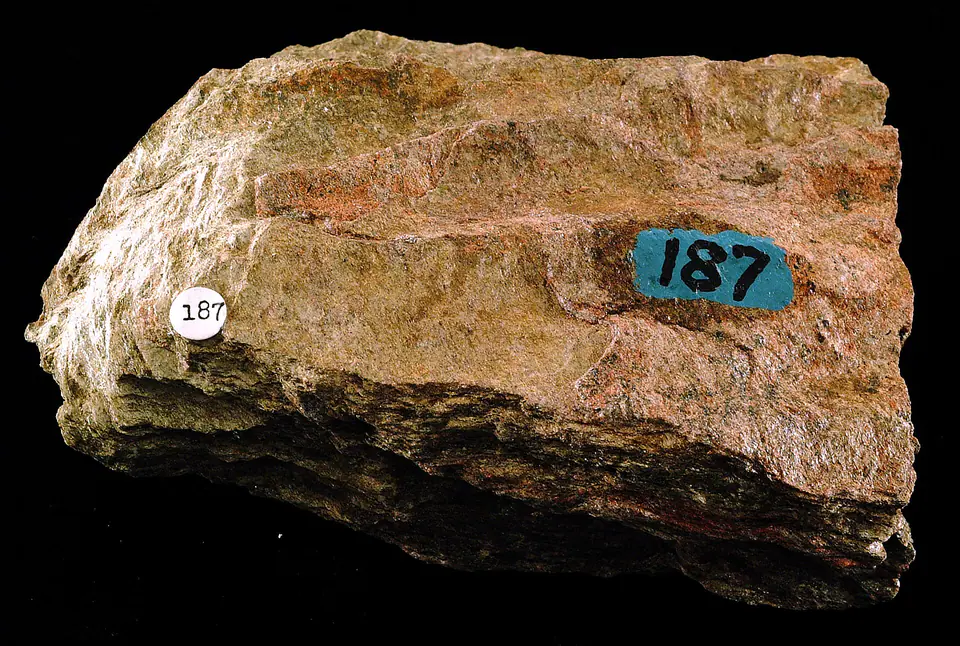
Schistosity is commonly wavy and glittering because mica grains are large enough to see. Larger metamorphic crystals may grow across or within the foliation.
Mineral names often modify “schist,” such as mica schist or garnet schist, but a reliable modifier requires that the mineral actually be identified.
Identification tests
Begin with observation and use the least destructive test first. Results can change with weathering, mixtures, coatings, and grain size. Review the step-by-step field-test methods before altering an unfamiliar specimen.
Foliation
Visible aligned platy mineralsSeparates schist from nonfoliated marble and quartzite.
Grain size
Mica and other grains visible unaidedCoarser than slate and commonly coarser than phyllite.
Splitting
Breaks along wavy schistosityGneiss is usually more compositionally banded and blocky.
Useful procedures: Cleavage versus fracture
Common lookalikes
How does it form?
Schist generally forms at metamorphic grades above slate and phyllite, where recrystallization produces larger minerals and stronger foliation.
Directed pressure rotates and grows platy minerals into parallel alignment while chemical reactions create new mineral assemblages.
Geologic setting and occurrence
Schist is widespread in regional metamorphic belts and can record mountain-building pressure, heat, and deformation.
Weathering may release resistant garnet or other minerals into soil and stream sediment, but occurrence does not imply legal or economic collecting potential.
Uses and significance
Schist is used locally as decorative or landscaping stone, though pronounced foliation can make it unsuitable for some structural applications.
Field notes
- Loose mica-rich slabs can be slippery and unstable.
- Porphyroblast identification should use multiple properties, not color alone.
- Some metamorphic terrains contain fibrous minerals; avoid creating dust from unknown material.
This guide supports preliminary field identification, not a laboratory determination, appraisal, hazard assessment, or statement of ownership or collecting permission. Verify land status and local rules before handling or collecting material.
Authoritative sources
LithoMap wrote this guide in original language using the scientific concepts and physical-property standards supported by these sources.
- How Rocks Are Classified U.S. National Park Service
- Rocks and Minerals U.S. National Park Service
- What is the difference between a rock and a mineral? U.S. Geological Survey
Editorial review: September 17, 2026.