
.jpg)
What is phyllite?
Phyllite commonly contains microscopic muscovite or sericite, chlorite, quartz, and feldspar, with composition inherited from a mud-rich parent rock and modified by metamorphic reactions.
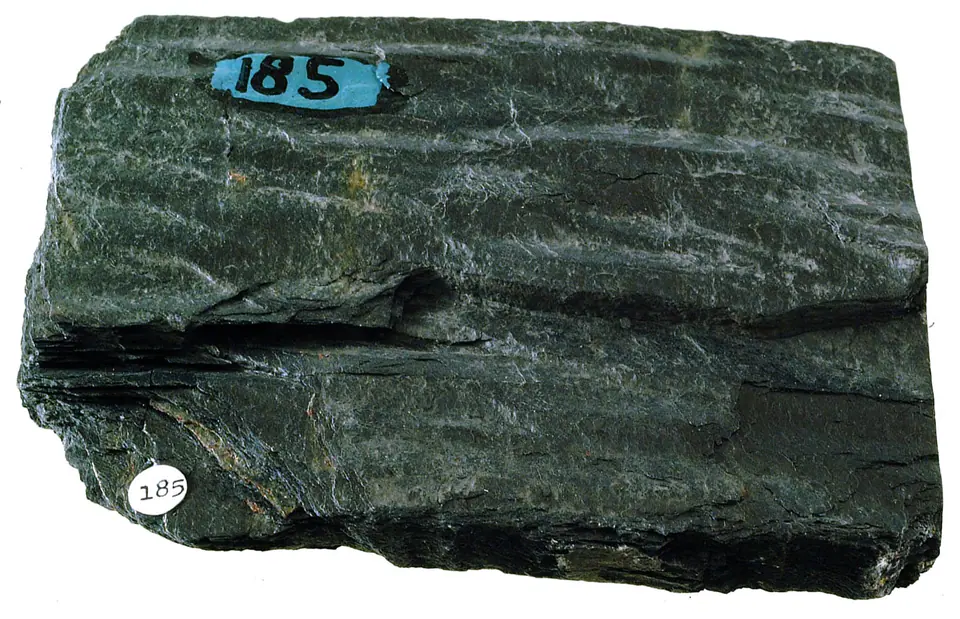
What does phyllite look like?
The sheen changes as the sample rotates because tiny aligned mica grains reflect light. Surfaces may be silver-gray, greenish, reddish, purple, or dark gray.
Foliation is usually less perfectly planar than slate cleavage and may wrap around small lenses or produce corrugated surfaces. Individual mica flakes remain difficult to see without magnification.
Identification tests
Begin with observation and use the least destructive test first. Results can change with weathering, mixtures, coatings, and grain size. Review the step-by-step field-test methods before altering an unfamiliar specimen.
Luster
Silky sheen across foliationA primary clue distinguishing phyllite from duller slate.
Grain size
Mica generally not individually visible unaidedSeparates phyllite from coarser schist.
Foliation
Wavy, crinkled, or gently folded surfacesMore irregular than typical planar slaty cleavage.
Common lookalikes
How does it form?
Phyllite forms when slate or mud-rich sedimentary rock experiences additional heat, pressure, and recrystallization during regional metamorphism.
It represents a broad textural grade between slate and schist rather than one exact temperature or pressure.
Geologic setting and occurrence
Phyllite occurs in regional metamorphic belts where mud-rich rocks reached low to moderate metamorphic grade, including parts of the Appalachians and western mountain belts.
Boundaries with slate and schist are gradual; field names should reflect the observed fabric and grain size rather than false precision.
Uses and significance
Phyllite is used locally for decorative stone, paving, roofing, and landscaping where cleavage, durability, and weather resistance are suitable.
Field notes
- Rotate the sample in diffuse light to see the sheen.
- Thin foliation slabs can be sharp and unstable underfoot.
- Avoid creating dust from unknown metamorphic rock.
This guide supports preliminary field identification, not a laboratory determination, appraisal, hazard assessment, or statement of ownership or collecting permission. Verify land status and local rules before handling or collecting material.
Authoritative sources
LithoMap wrote this guide in original language using the scientific concepts and physical-property standards supported by these sources.
- Metamorphic Rocks U.S. National Park Service
- How Rocks Are Classified U.S. National Park Service
- Rocks and Minerals U.S. National Park Service
- What is the difference between a rock and a mineral? U.S. Geological Survey
Editorial review: September 17, 2026.