
.jpg)
What is obsidian?
Most obsidian is silica-rich and compositionally related to rhyolite, although appearance varies with bubbles, crystallites, inclusions, and oxidation. Black color does not mean the glass is compositionally basaltic.
What does obsidian look like?
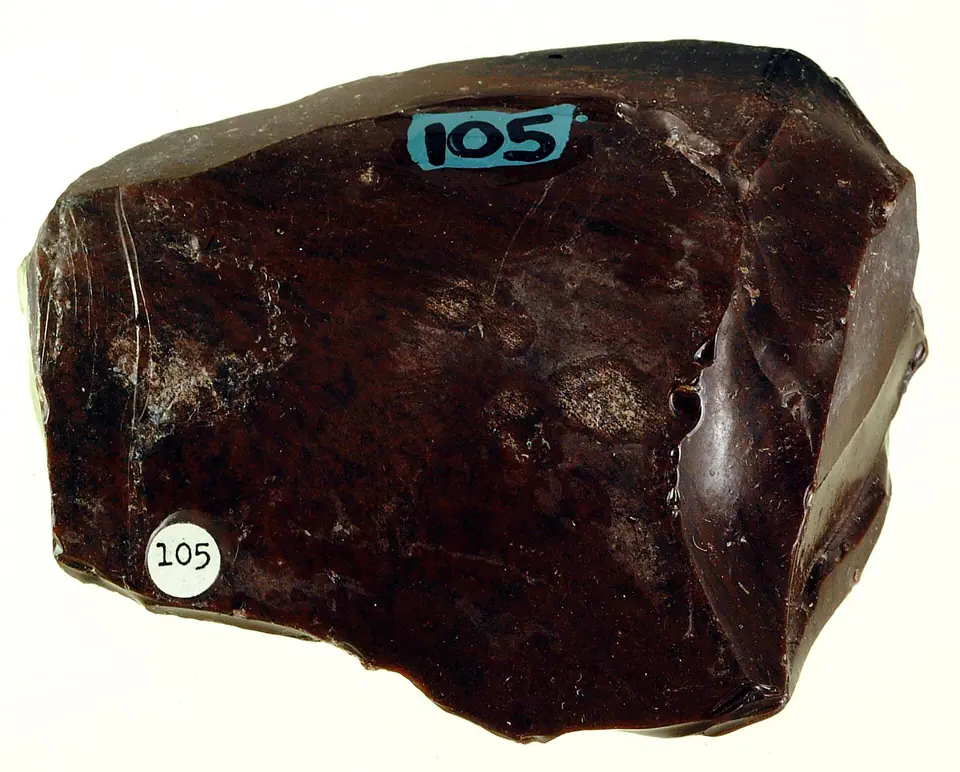
Fresh obsidian has a smooth vitreous surface and concentric fracture ripples. Snowflake, mahogany, sheen, and banded varieties reflect internal crystals, bubbles, or compositional structures.
Hydration and devitrification gradually alter volcanic glass. Weathered surfaces can become dull, pitted, or coated, while interiors remain glassy.
Identification tests
Begin with observation and use the least destructive test first. Results can change with weathering, mixtures, coatings, and grain size. Review the step-by-step field-test methods before altering an unfamiliar specimen.
Fracture
Strong conchoidal fracture with curved ripplesA key clue shared with manufactured glass and some quartz-rich materials.
Hardness
About 5 to 5.5; may scratch ordinary glass weaklySofter than quartz despite its glassy appearance.
Bubbles
May contain stretched or sparse bubblesUniform bubbles and artificial colors can indicate bottle glass or slag.
Useful procedures: Cleavage versus fracture · Mohs hardness test
Common lookalikes
Manufactured glass
Often occurs with cultural debris, mold seams, uniform curvature, or artificial color; archaeological glass must not be disturbed.
Slag
May contain abundant bubbles, metallic particles, or industrial residue and lacks a volcanic geologic setting.
Black chert
Can fracture conchoidally but has a waxier luster and microcrystalline rather than truly glassy fabric.
How does it form?
Obsidian develops where lava cools rapidly enough to suppress crystal growth, often along flow margins, domes, or shallow volcanic bodies.
Natural glass is geologically unstable over long time spans and commonly develops microscopic crystals or hydration rinds after formation.
Geologic setting and occurrence
Obsidian is restricted to volcanic settings capable of producing glassy silica-rich melt. Pieces may be transported naturally or by people far from their volcanic source.
Archaeological obsidian artifacts are protected cultural materials, not collectible float. Context matters as much as physical appearance.
Uses and significance
Obsidian was widely shaped into cutting tools and remains important in archaeology, experimental knapping, jewelry, and decorative work.
Field notes
- Fresh edges can cause deep cuts; use eye protection and never test by running a finger along an edge.
- Do not collect or move artifacts, flakes, or material at archaeological sites.
- Verify land rules before collecting natural specimens.
This guide supports preliminary field identification, not a laboratory determination, appraisal, hazard assessment, or statement of ownership or collecting permission. Verify land status and local rules before handling or collecting material.
Authoritative sources
LithoMap wrote this guide in original language using the scientific concepts and physical-property standards supported by these sources.
- Igneous Rocks U.S. National Park Service
- How Rocks Are Classified U.S. National Park Service
- Rocks and Minerals U.S. National Park Service
- What is the difference between a rock and a mineral? U.S. Geological Survey
Editorial review: September 17, 2026.