
.jpg)
What is dolostone?
Dolostone is dominated by the carbonate mineral dolomite, calcium magnesium carbonate. It may also contain calcite, chert, clay, quartz, fossils, evaporite minerals, or iron-bearing impurities. “Dolomite” can mean either the mineral or, historically, the rock; “dolostone” keeps the distinction clear.
What does dolostone look like?
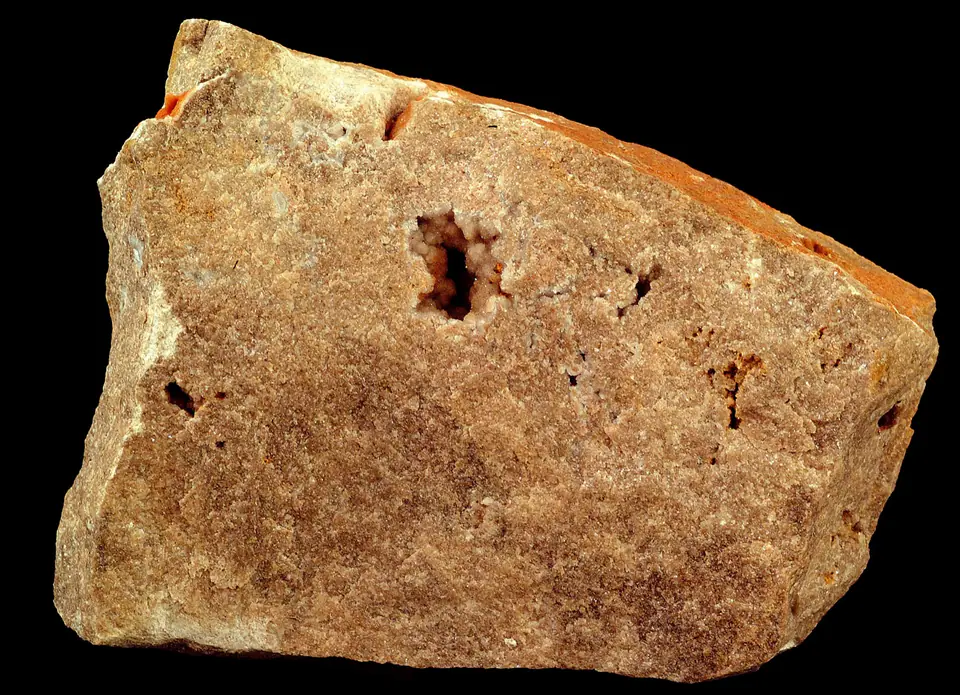
Many dolostones are fine grained and resemble limestone. Others show a sugary mosaic of tiny rhombohedral crystals, porous weathering, or buff and brown surfaces caused by iron-bearing impurities.
Bedding, fossils, nodules, cavities, or sedimentary structures may survive, although recrystallization and replacement can blur original textures.
Identification tests
Begin with observation and use the least destructive test first. Results can change with weathering, mixtures, coatings, and grain size. Review the step-by-step field-test methods before altering an unfamiliar specimen.
Acid response
Weak or delayed fizz on a fresh surface; stronger when powderedSupports dolomite-rich rock but mixtures and weathering can change the response.
Hardness
About 3.5 to 4 for dolomite grainsSlightly harder than calcite-rich limestone and may resist a copper scratch more strongly.
Texture
Fine to sugary crystalline carbonateUseful with acid behavior, but not diagnostic by itself.
Useful procedures: Acid reaction test · Mohs hardness test
Common lookalikes
How does it form?
Much dolostone forms when magnesium-rich fluids alter earlier limestone or carbonate sediment, replacing calcite with dolomite during burial or diagenesis.
Some dolomite can precipitate directly or form in specialized modern settings, but a hand sample rarely reveals the exact pathway.
Geologic setting and occurrence
Dolostone is widespread in carbonate platforms and sedimentary basins, including thick Paleozoic sequences across the Midwest, Great Lakes, Appalachians, and interior United States.
A single hand sample cannot establish whether dolomitization was early, burial-related, hydrothermal, or tied to one named stratigraphic unit.
Uses and significance
Dolostone is quarried for aggregate, construction stone, agricultural lime, refractory and chemical feedstock, and magnesium-bearing products where purity and specifications are suitable.
Field notes
- Use acid only on an expendable fresh spot and wear eye protection.
- Do not acid-test monuments, finished stone, fossils, or protected outcrops.
- Mixed calcite and dolomite can produce intermediate reactions.
This guide supports preliminary field identification, not a laboratory determination, appraisal, hazard assessment, or statement of ownership or collecting permission. Verify land status and local rules before handling or collecting material.
Authoritative sources
LithoMap wrote this guide in original language using the scientific concepts and physical-property standards supported by these sources.
- Sedimentary Rocks U.S. National Park Service
- How Rocks Are Classified U.S. National Park Service
- Rocks and Minerals U.S. National Park Service
- What is the difference between a rock and a mineral? U.S. Geological Survey
Editorial review: September 17, 2026.