
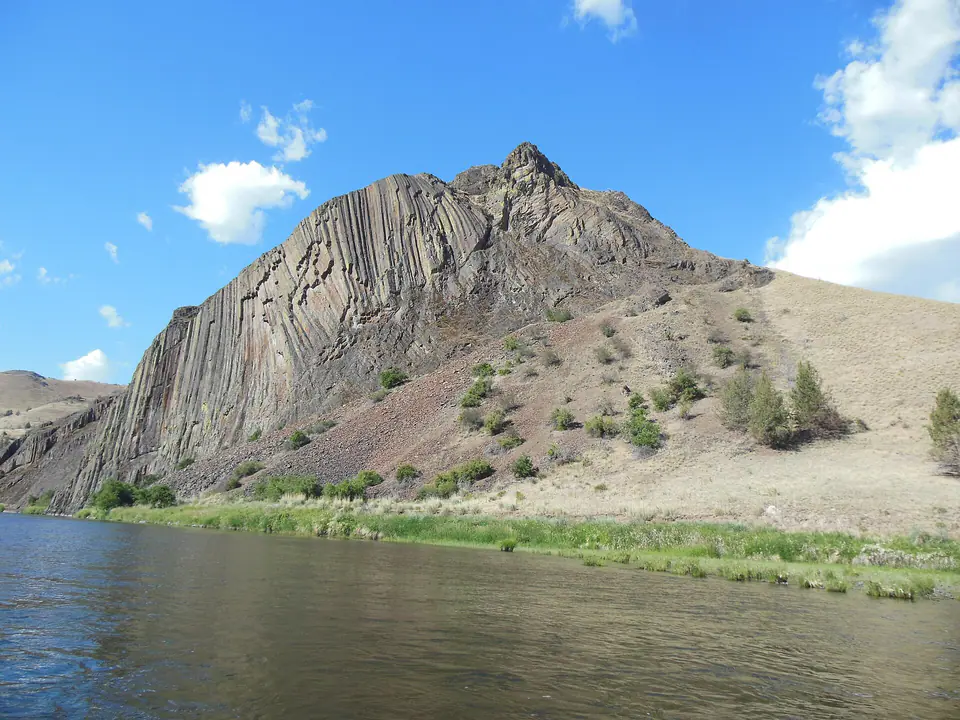

Where is the Clarno Formation?
Clarno rocks crop out widely in central Oregon, including the Clarno Unit of John Day Fossil Beds National Monument. Thick volcanic and volcaniclastic successions preserve deposits formed near active Eocene volcanic centers.
The formation includes many rock types and local volcanic packages. Fossil localities such as the Clarno Nut Beds and Hancock Mammal Quarry represent small, exceptional windows within a much larger volcanic landscape.
How did it form?
Andesitic volcanoes produced lava flows, ash, breccia, and fast-moving lahars. Rivers and basins between volcanic centers reworked debris into conglomerate, sandstone, mudstone, and ancient soils.
Some lahars rapidly buried forests, while silica-rich fluids and burial cemented wood and sediment. Long pauses between eruptions allowed soils and ecosystems to develop before the next volcanic episode.
Fossil record
Leaves, wood, fruits, nuts, seeds, pollen, and vertebrates document a warm Eocene forest. The Nut Beds are especially important for plant diversity, while the Hancock Mammal Quarry preserves land mammals and other vertebrates.
Fossil concentration depends on the deposit: lahars may entomb woody debris, quiet sediment can preserve leaves, and channel or quarry beds may concentrate bone. Most lava flows contain no fossils.
Compare observable anatomy in the fossil identification guides, then review the U.S. fossil collecting-law guide before disturbing any find. A formation-level record does not prove a fossil is present, exposed, common, or legal to collect at a particular place.
Minerals and geological resources
Plagioclase feldspar and pyroxene are common in volcanic rock, with volcanic glass and ash altered to clay minerals. Silica cement and replacement helped preserve wood, nuts, and other plant material.
Iron oxides color ancient soils and weathered volcanic debris. Secondary minerals may line cavities or fractures, but their occurrence is local and protected within the monument.
Identify rocks and minerals named in this guide
Use physical properties to investigate materials discussed above. A formation name or mapped location supports context, but it cannot identify a hand sample by itself.
What to know in the field
- Collecting is prohibited within John Day Fossil Beds National Monument.
- Volcanic breccia and lahar cliffs contain poorly supported blocks that can fall without warning.
- Clarno and John Day rocks record different volcanic episodes and should not be treated as interchangeable.
Formation, fossil, and mineral information is educational. It does not establish land ownership, legal access, collecting permission, specimen identity, or present-day field conditions.
Authoritative sources
This guide synthesizes the following sources in original language. Consult the linked records for local stratigraphic detail and the underlying scientific literature.
- Clarno Formation National Park Service
- NPS Geodiversity Atlas—John Day Fossil Beds National Park Service
Editorial review: September 16, 2026.