
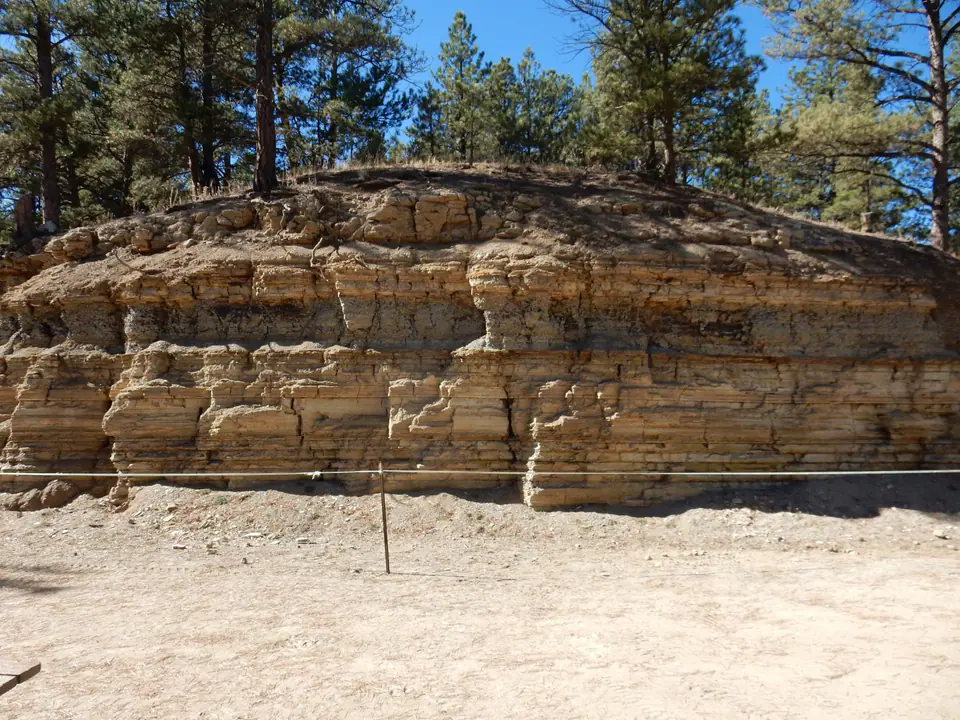

Where is the Florissant Formation?
The formation is centered on the Florissant basin west of Colorado Springs. Its celebrated exposures are protected within Florissant Fossil Beds National Monument, and the geographically limited unit is far smaller than continental-scale formations such as the Morrison.
Lake shales, volcanic ash, stream deposits, and coarse volcanic debris occur in a compact basin. Their arrangement records a landscape repeatedly changed by eruptions from the nearby Thirtynine Mile volcanic field.
How did it form?
A freshwater lake occupied the valley while streams supplied sediment and nearby volcanoes supplied ash and debris. Fine mud settled through quiet water in thin layers. At other times, lahars—fast volcanic mudflows—swept into the valley and buried trees and older sediment.
Volcanic ash could trigger algal blooms and changes in lake chemistry that helped preserve delicate organisms. The formation therefore links ordinary lake sedimentation with episodic volcanic disturbance rather than representing a single catastrophic burial.
Fossil record
Florissant is famous for detailed insects, spiders, leaves, seeds, pollen, fish, birds, and mammals. The lake beds preserve delicate wings and leaf venation, while upright petrified stumps record huge trees related to modern redwoods.
The assemblage provides an unusually broad view of a late Eocene ecosystem. Fossils document both aquatic and terrestrial organisms, allowing scientists to reconstruct vegetation, climate, food webs, and environmental change.
Compare observable anatomy in the fossil identification guides, then review the U.S. fossil collecting-law guide before disturbing any find. A formation-level record does not prove a fossil is present, exposed, common, or legal to collect at a particular place.
Minerals and geological resources
Volcanic ash and tuff contain fine quartz and feldspar, with clay minerals produced as ash altered after deposition. Silica played a major role in petrifying wood, and iron minerals contribute color to weathered beds.
The formation is scientifically important for fossils rather than as a collecting district. Mineral grains are commonly microscopic or locked within soft tuff and shale, and all natural materials are protected inside the national monument.
Identify rocks and minerals named in this guide
Use physical properties to investigate materials discussed above. A formation name or mapped location supports context, but it cannot identify a hand sample by itself.
What to know in the field
- Fossil and mineral collecting is prohibited within Florissant Fossil Beds National Monument.
- Soft shale can crumble quickly after exposure; scientific excavation and conservation are specialized work.
- Do not confuse the Eocene formation with much younger Ice Age deposits that also occur in the area.
Formation, fossil, and mineral information is educational. It does not establish land ownership, legal access, collecting permission, specimen identity, or present-day field conditions.
Authoritative sources
This guide synthesizes the following sources in original language. Consult the linked records for local stratigraphic detail and the underlying scientific literature.
- Florissant geologic trail National Park Service
- Florissant Fossil Beds frequently asked questions National Park Service
Editorial review: September 16, 2026.