
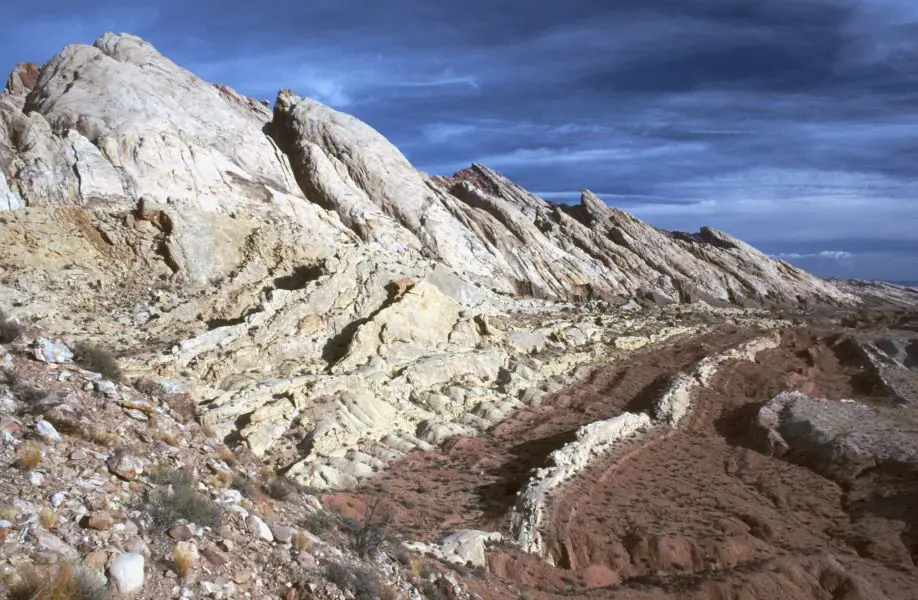

Where is the Navajo Sandstone?
Navajo Sandstone is exposed widely across southern Utah and northern Arizona, with extensions and correlated usage in neighboring Colorado and Nevada. It builds some of the best-known cliffs and slickrock landscapes at Zion, Glen Canyon, Capitol Reef, and Canyonlands.
Thickness and color change markedly across the region. The formation exceeds 2,000 feet in parts of southwestern Utah but thins elsewhere, and iron-bearing coatings can produce red, orange, pink, cream, or nearly white rock from the same quartz-rich unit.
How did it form?
Wind moved well-sorted sand across a dry continental interior and built dunes whose sloping lee faces became large cross-bed sets. Small ponds and damp interdune flats occasionally interrupted the dune field, leaving thin carbonate or muddy layers among the sandstone.
Burial compacted the sand and groundwater deposited cement between grains. Later uplift and erosion exposed the dune architecture. Joints, variable cement, and groundwater flow now guide the formation of alcoves, fins, domes, and canyons.
Fossil record
Body fossils are uncommon in the dry dune deposits, but tracks and other trace fossils record dinosaurs and smaller animals crossing moist sand. Burrows and rare remains from interdune ponds add evidence of life in wetter pockets.
Trace fossils are concentrated on particular bedding surfaces and can be subtle. A broad Navajo Sandstone exposure should not be assumed to contain tracks, and suspected tracksites should be left undisturbed for expert documentation.
Compare observable anatomy in the fossil identification guides, then review the U.S. fossil collecting-law guide before disturbing any find. A formation-level record does not prove a fossil is present, exposed, common, or legal to collect at a particular place.
Minerals and geological resources
Quartz overwhelmingly dominates the sand grains. Calcite and silica occur as cement, while iron oxides coat grains and stain fractures. Resistant zircon grains occur in tiny amounts and have helped researchers trace older sediment sources.
Dark desert varnish on exposed surfaces may contain manganese and iron oxides mixed with clay. Varnish is a surface coating, not a separate bed, and damaging it can destroy both natural and cultural records.
Identify rocks and minerals named in this guide
Use physical properties to investigate materials discussed above. A formation name or mapped location supports context, but it cannot identify a hand sample by itself.
What to know in the field
- Rounded slickrock can become extremely slippery with sand, frost, or rain.
- The porous formation is an important aquifer, but springs and seeps are fragile habitats rather than guaranteed water sources.
- Collecting and off-trail travel are restricted in many parks, monuments, and tribal lands across its outcrop belt.
Formation, fossil, and mineral information is educational. It does not establish land ownership, legal access, collecting permission, specimen identity, or present-day field conditions.
Authoritative sources
This guide synthesizes the following sources in original language. Consult the linked records for local stratigraphic detail and the underlying scientific literature.
- Navajo Sandstone National Park Service
- NPS Geodiversity Atlas—Navajo National Monument National Park Service
- Source of the Navajo sand National Park Service
Editorial review: September 16, 2026.