
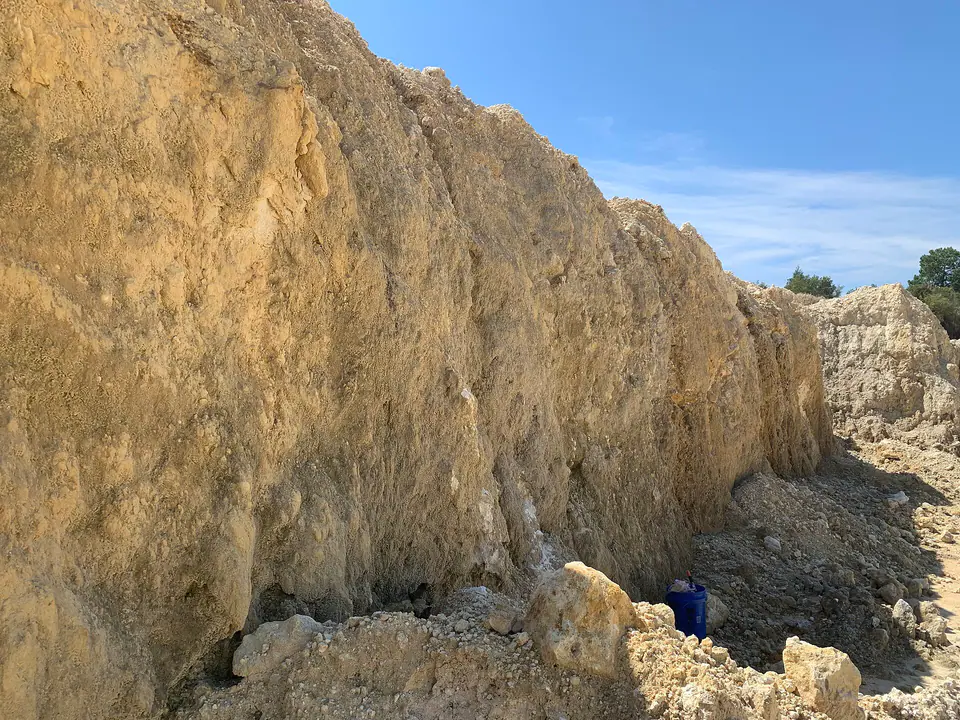

Where is the Suwannee Limestone?
The unit is exposed along portions of the Suwannee River and in west-central Florida and lies beneath younger sediment across a much larger area. It is absent or difficult to distinguish in parts of northern and eastern Florida.
Thickness varies from thin erosional remnants to hundreds of feet in the subsurface. Ocala Limestone generally lies below, while younger Miocene units rest above across unconformities.
How did it form?
Carbonate mud and skeletal grains accumulated in warm shallow water on the Florida Platform. Changes in water depth, circulation, and exposure produced micritic, crystalline, fossiliferous, and locally dolomitic rock.
Later freshwater circulation dissolved limestone and enlarged fractures, while magnesium-rich fluids converted some calcite to dolomite. Erosion created irregular upper and lower contacts.
Fossil record
Mollusks, benthic foraminifera, echinoids, and other shallow-marine organisms occur commonly. Fossil assemblages help separate the unit from older Ocala and younger carbonate formations.
Recrystallization or dolomitization can obscure shells, and a fossil-rich hand sample does not establish a precise member or contact without mapped context.
Compare observable anatomy in the fossil identification guides, then review the U.S. fossil collecting-law guide before disturbing any find. A formation-level record does not prove a fossil is present, exposed, common, or legal to collect at a particular place.
Minerals and geological resources
Calcite is dominant, with dolomite common in altered zones and minor quartz sand, clay, and iron oxides. Cavities may contain secondary calcite crystals.
The formation contributes to the Floridan aquifer system and supplies carbonate aggregate in some areas. Water movement through solution openings can be rapid and uneven.
Identify rocks and minerals named in this guide
Use physical properties to investigate materials discussed above. A formation name or mapped location supports context, but it cannot identify a hand sample by itself.
What to know in the field
- River exposures may be submerged or dangerously swift depending on water level.
- Karst openings and thin roofs can be hidden by soil or vegetation.
- Check land ownership and spring-protection rules before approaching an exposure.
Formation, fossil, and mineral information is educational. It does not establish land ownership, legal access, collecting permission, specimen identity, or present-day field conditions.
Authoritative sources
This guide synthesizes the following sources in original language. Consult the linked records for local stratigraphic detail and the underlying scientific literature.
- Geolex Suwannee unit record U.S. Geological Survey
- Geolex Suwannee references U.S. Geological Survey
Editorial review: September 16, 2026.