
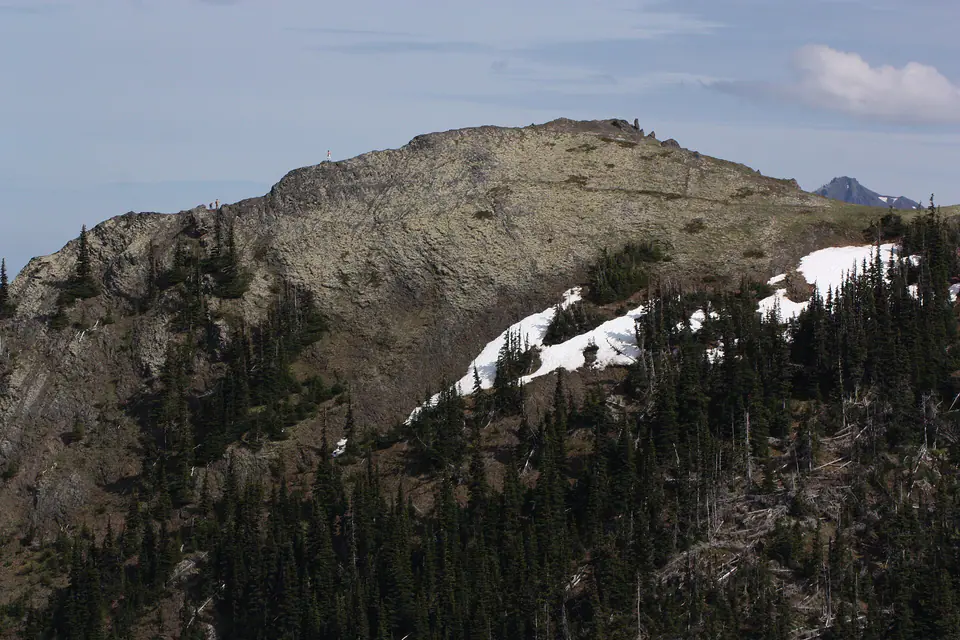

Where is the Crescent Formation?
Crescent rocks form much of the eastern and northern Olympic Peninsula and extend beneath younger rocks. Excellent exposures occur around parts of the Strait of Juan de Fuca, Hood Canal, and the Olympic Mountains, although vegetation and deformation obscure many contacts.
Regional maps divide the thick volcanic package in different ways, and closely related Siletzia rocks continue southward into Oregon. The formation name should not be assumed for every basalt in western Washington.
How did it form?
Basalt erupted onto and beneath the ocean, creating pillow lava, massive flows, breccia, and volcanic sediment. Continued eruption built unusually thick oceanic crust that was later accreted to the continent and uplifted with the Olympic Peninsula.
Some upper flows erupted in shallower water or on volcanic islands, while marine sediment accumulated between eruptive episodes. Folding, faulting, metamorphism, and hydrothermal alteration subsequently modified the original volcanic minerals.
Fossil record
Most basalt flows contain no fossils, but interbedded marine sediment and limestone locally preserve foraminifera and other microfossils that constrain the formation’s Eocene age.
Fossil occurrence depends on finding sediment deposited between eruptions. A volcanic outcrop alone is unlikely to show body fossils even where fossil-bearing beds occur elsewhere in the formation.
Compare observable anatomy in the fossil identification guides, then review the U.S. fossil collecting-law guide before disturbing any find. A formation-level record does not prove a fossil is present, exposed, common, or legal to collect at a particular place.
Minerals and geological resources
Plagioclase and pyroxene are major primary basalt minerals, with magnetite and volcanic glass also common. Alteration can produce chlorite, clay minerals, calcite, quartz, and zeolites in fractures and cavities.
Secondary mineral fillings record seawater circulation and later burial, but collectible material is localized and may be protected on public land or inaccessible on steep coastal outcrops.
Identify rocks and minerals named in this guide
Use physical properties to investigate materials discussed above. A formation name or mapped location supports context, but it cannot identify a hand sample by itself.
What to know in the field
- Wet basalt, moss, and steep coastal slopes create serious fall hazards.
- Rock collecting is prohibited in Olympic National Park and may be restricted elsewhere.
- Distinguish Crescent basalt from younger Cascade and local intrusive rocks with a current map.
Formation, fossil, and mineral information is educational. It does not establish land ownership, legal access, collecting permission, specimen identity, or present-day field conditions.
Authoritative sources
This guide synthesizes the following sources in original language. Consult the linked records for local stratigraphic detail and the underlying scientific literature.
- Geolex Crescent references U.S. Geological Survey
- Geologic history of Siletzia U.S. Geological Survey
Editorial review: September 16, 2026.