
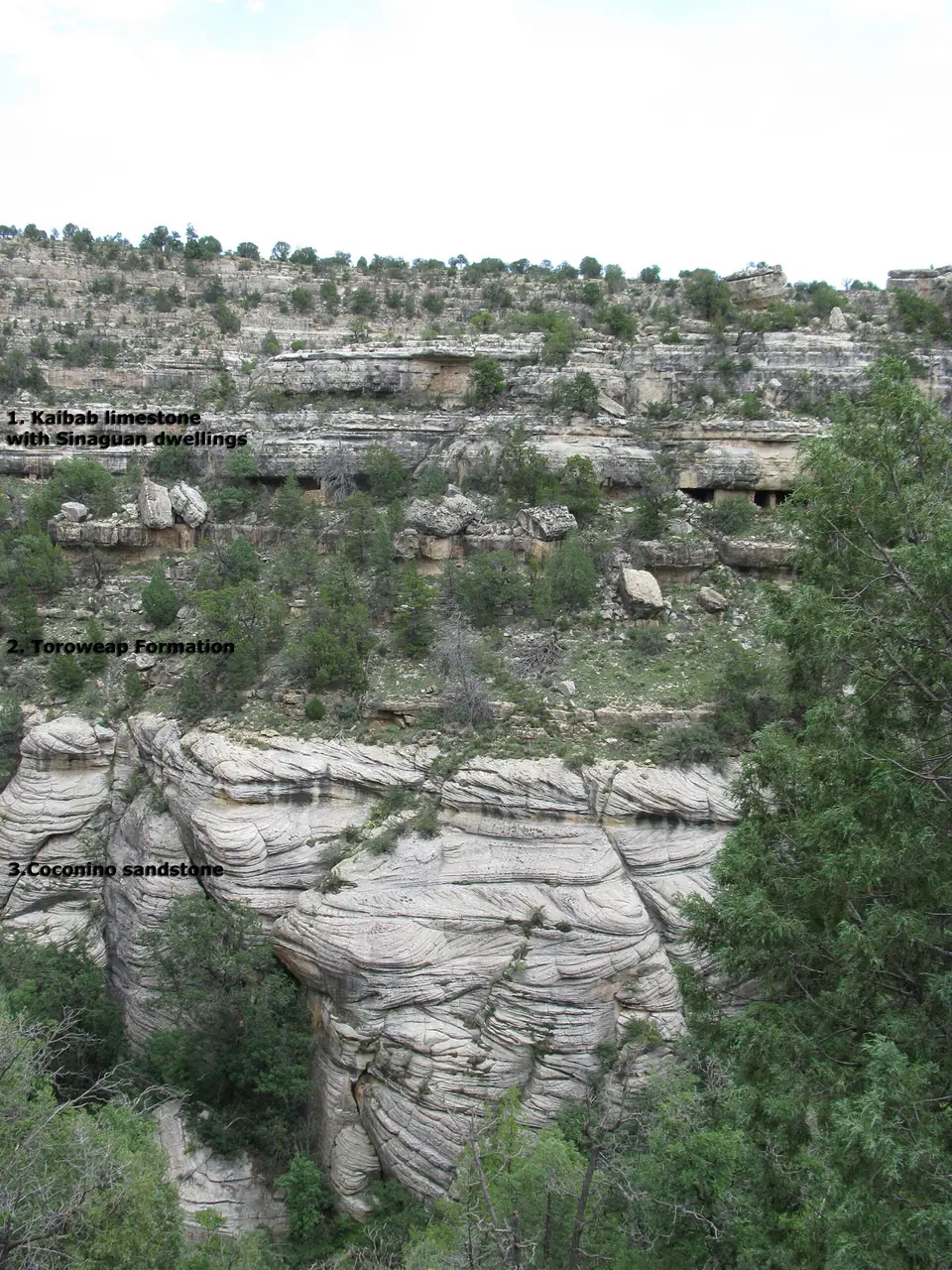

Where is the Kaibab Formation?
The formation is widespread across northern Arizona and extends into southern Utah and southeastern Nevada. At the Grand Canyon it caps large portions of the plateau, while farther east and west its composition and subdivisions change.
Modern usage favors “Kaibab Formation” because the unit is not limestone everywhere. West of a broad north–south boundary in Arizona it is commonly divided into the Fossil Mountain and Harrisburg Members; eastern equivalents can be more sandy and remain undivided.
How did it form?
Warm, shallow marine water covered the region during part of Permian time. Carbonate mud, shells, and skeletal debris became limestone and dolostone, while silica formed nodules and beds of chert. Shoreline sand and restricted, evaporating water produced sandstone and gypsum-bearing intervals.
The formation captures more than one environment and more than one shoreline position. The fossiliferous, cliff-forming Fossil Mountain Member differs from the more varied Harrisburg Member, which includes carbonate, sandstone, red beds, chert, and gypsum.
Fossil record
Common fossils include brachiopods, bryozoans, sponges, crinoid fragments, mollusks, echinoids, cephalopods, and other marine invertebrates. Fossil Mountain Member exposures are especially well known for marine fossils.
Most fossils are hard parts or impressions of seafloor organisms. Preservation and abundance vary with rock type; gypsum-rich or sandy beds generally tell a different environmental story than fossiliferous limestone.
Compare observable anatomy in the fossil identification guides, then review the U.S. fossil collecting-law guide before disturbing any find. A formation-level record does not prove a fossil is present, exposed, common, or legal to collect at a particular place.
Minerals and geological resources
Calcite and dolomite dominate the carbonate rocks. Chert consists of microcrystalline quartz, and gypsum is conspicuous in some upper or western intervals. Quartz is also common in sandstone, with clay minerals and iron oxides in finer or red beds.
Chert nodules weather out of limestone and may resemble collectible silica material, but removal may be prohibited. Mineral presence is a description of the rock—not permission to collect within a park, monument, tribal land, or other restricted area.
Identify rocks and minerals named in this guide
Use physical properties to investigate materials discussed above. A formation name or mapped location supports context, but it cannot identify a hand sample by itself.
What to know in the field
- Kaibab limestone and chert can make rough, sharp terrain with hidden solution cavities.
- Collecting is prohibited in Grand Canyon National Park and other National Park Service units.
- The rim-forming unit may be thin, faulted, or removed by erosion away from familiar viewpoints.
Formation, fossil, and mineral information is educational. It does not establish land ownership, legal access, collecting permission, specimen identity, or present-day field conditions.
Authoritative sources
This guide synthesizes the following sources in original language. Consult the linked records for local stratigraphic detail and the underlying scientific literature.
- Geolex Kaibab references U.S. Geological Survey
- Geolex Fossil Mountain references U.S. Geological Survey
Editorial review: September 16, 2026.