

Where is the Trenton Limestone?
Trenton-named carbonate rocks are exposed most famously in New York and continue in the subsurface across parts of the Appalachian, Michigan, and adjacent interior basins. Equivalent sections may be mapped as the Trenton Group or divided into several formations.
The type-region history is complicated by more than a century of revisions. A well or outcrop labeled Trenton in one state may not encompass exactly the same beds as a Trenton interval elsewhere.
How did it form?
Lime mud and skeletal debris accumulated on a broad marine shelf. Changes in water depth, storm energy, mud supply, and seafloor oxygen produced alternating limestone and shale and helped define regional members.
Burial compacted the carbonate sediment and calcite cement filled pores and fractures. Later dolomitization affected some intervals, while tectonic loading and basin subsidence controlled thickness and organic-rich facies.
Fossil record
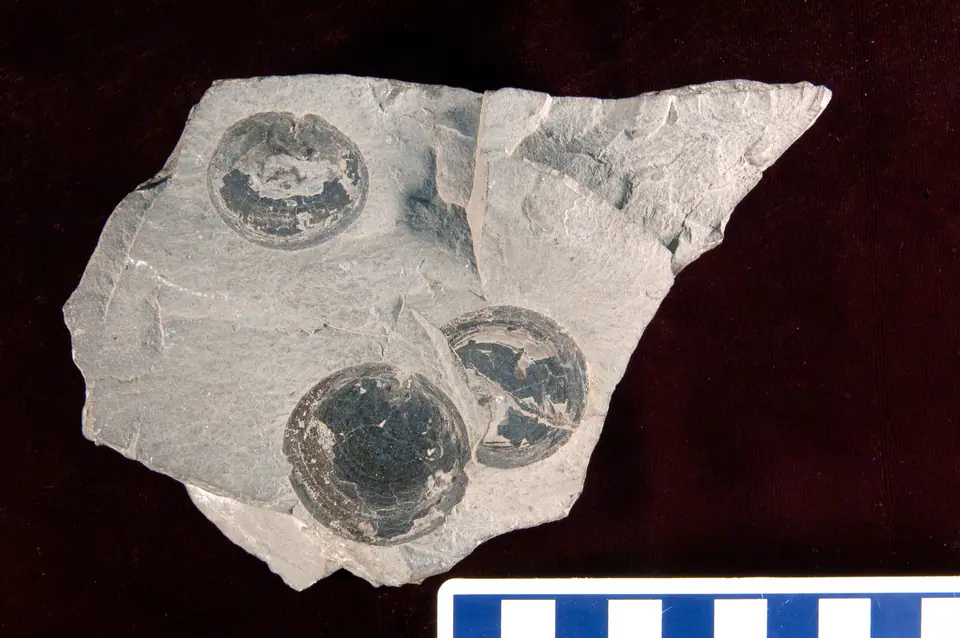
Brachiopods, bryozoans, gastropods, cephalopods, trilobites, crinoid fragments, and other marine organisms occur in many Trenton beds. Fossil assemblages change vertically and across the shelf.
Shell-rich limestone may be easy to recognize, but fossil content alone cannot distinguish every Trenton subdivision. Broken storm beds, burrowed carbonate, and quieter shaly intervals can occur close together.
Compare observable anatomy in the fossil identification guides, then review the U.S. fossil collecting-law guide before disturbing any find. A formation-level record does not prove a fossil is present, exposed, common, or legal to collect at a particular place.
Minerals and geological resources
Calcite is the principal mineral, with clay minerals and quartz concentrated in shaly beds. Dolomite occurs where carbonate alteration was stronger, and pyrite may be present in darker, oxygen-poor intervals.
Hydrocarbon reservoirs are associated with fractured or altered Trenton–Black River carbonates in some basins. Oil and gas are resources rather than minerals, and subsurface production does not imply surface collecting potential.
Identify rocks and minerals named in this guide
Use physical properties to investigate materials discussed above. A formation name or mapped location supports context, but it cannot identify a hand sample by itself.
What to know in the field
- Confirm whether a local source uses Trenton as a group, formation, or informal subsurface interval.
- Limestone quarries and roadcuts can have unstable faces and require explicit access permission.
- Fossil-rich beds may be protected or scientifically sensitive even outside parks.
Formation, fossil, and mineral information is educational. It does not establish land ownership, legal access, collecting permission, specimen identity, or present-day field conditions.
Authoritative sources
This guide synthesizes the following sources in original language. Consult the linked records for local stratigraphic detail and the underlying scientific literature.
- Geolex Trenton references U.S. Geological Survey
- Trenton limestone stratigraphy and fossils U.S. Geological Survey
Editorial review: September 16, 2026.